Heat Powered vs Electric Stove Fan: Which One Should You Buy?
Heat powered vs electric stove fan compared: how thermoelectric stovetop fans work, what the listings state, and when a plug-in fan wins.

On this page
Top picks at a glance
As an Amazon Associate we earn from qualifying purchases.
- 1
 Ecofan UltrAir Heat Powered Stove Fan9.6/10View on Amazon
- 2
 VODA Wood Stove Fan Heat Powered 8 Blades Fireplace Fan with9.6/10View on Amazon
- 3
 VODA Wood Stove Fan Heat Powered Fireplace Fans 8 Blades Non9.6/10View on Amazon
- 4
 Ecofan AirMax Heat Powered Stove FanView on Amazon
- 5
 Ecofan AirDeco I Heat Powered Stove FanView on Amazon
- 6
 Dual Motors Heat Powered Fireplace FanView on Amazon
- 7
 Wood Stove Fan Heat PoweredView on Amazon
- 8
 JossaColar Heat Powered Wood Stove Fan with Safety GuardView on Amazon
- 9
 Tomersun Wood Stove Fan Heat Powered Stove Fan HeaterView on Amazon
The stove is roaring but the far corner of the room stays cold, and the heat powered vs electric stove fan question is really about where the power comes from: a heat-powered fan sits on the stovetop and turns stove heat into airflow with no cord at all, while an electric fan plugs into the wall and moves air on demand. Either one pushes warm air out into the room instead of letting it pool above the stove; the choice comes down to your room, your outlet situation and how much air you need moved.
More options to compare
 Ecofan AirMax Heat Powered Stove FanCheck price on Amazon
 Ecofan AirDeco I Heat Powered Stove FanCheck price on Amazon
 Dual Motors Heat Powered Fireplace FanCheck price on Amazon
 Wood Stove Fan Heat PoweredCheck price on Amazon
 JossaColar Heat Powered Wood Stove Fan with Safety GuardCheck price on Amazon
 Tomersun Wood Stove Fan Heat Powered Stove Fan HeaterCheck price on Amazon
FirewoodGearHQ may earn a small commission if you buy through links on this page. The price you pay stays the same. Read our affiliate disclosure.
The quick answer
Choose a heat-powered fan for a simple, silent setup: it sits on the stovetop, starts itself as the stove warms and needs no outlet, no batteries and no attention. The listings show the range: the Ecofan AirMax moves 175 CFM on 2 blades with a 2-year warranty, the VODA runs 8 blades at 25 db with a magnetic thermometer included, and the Easywave dual-motor fan pushes 180 plus CFM total. Choose an electric fan when you need stronger airflow, adjustable speeds on demand or circulation in a room far from the stove. No electric fan listings are included here, so the electric side below is general guidance without listing figures.
What heat-powered fans do
A heat-powered fan converts the temperature difference between the stovetop and the room into electricity through a thermoelectric module, the Seebeck motor the Ecofan listing names, and that electricity spins the blades. The hotter the stove, the faster the fan: the VODA listing states an operating range of 176F to 653F, starting around 140F and working most efficiently around 482F. Airflow runs from the Ecofan 175 CFM on 2 blades to the Easywave 180 plus CFM total, 90 CFM per head, on its dual-motor 6-blade design. Blade counts here run 2 to 8, and noise runs 24 to 25 db, essentially a whisper.
Placement is the stovetop itself, toward the back or side where the surface is hot but the fan is out of the way of the flue and the kettle. Several listings include a magnetic thermometer so you can watch the surface temperature: the VODA and HIDALIFE ship one, and the Sckee and Easywave too. The Signstek hangs from a hook instead of standing on the stove, and the TITECK and Sckee include trays and brackets for heaters and buddy heaters. The Ecofan measures 4 by 9 by 11.75 inches at 3 pounds with a 9-inch blade; the VODA is 4.3 by 6.3 by 6.7 inches at 1.2 pounds.
What electric fans do
An electric stove fan is a plug-in room fan pointed at or near the stove: it moves air on wall power, independent of the stovetop temperature. That independence is the whole advantage. It runs at full speed on a low fire, it keeps circulating after the stove cools, and it can sit across the room blowing warm air down a hallway where no stovetop fan could reach. Speeds are adjustable on demand rather than tied to the fire, and the airflow of a mains fan generally exceeds what a thermoelectric module can drive.
The trade-offs are the cord and the noise. An electric fan needs an outlet within reach of the stove, and the cord must stay clear of the hot surfaces. It draws power all winter, however little, and it is typically louder than the 24 to 25 db of the heat-powered listings here. It also keeps blowing when the stove is cold unless you switch it off, which is just moving room-temperature air.
Heat powered vs electric stove fan: the real difference
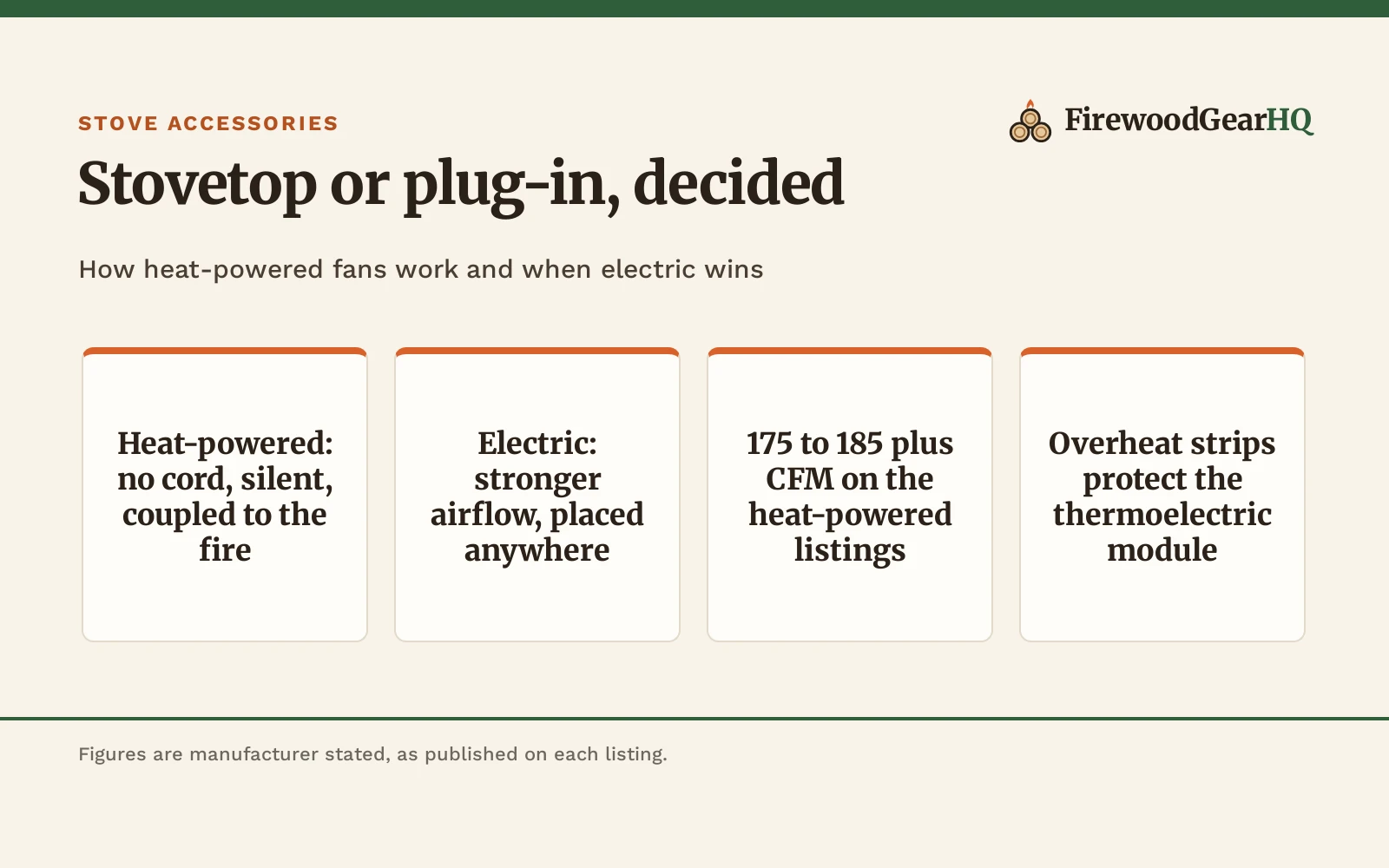
The real difference is coupling. The heat-powered fan is coupled to the fire: it starts when the stove warms, speeds up as the fire builds and slows as the fire dies, with no input from you. The electric fan is decoupled: it blows when you say so, at the speed you set, whether the stove is roaring or cold. For a cabin or a room without a nearby outlet, the heat-powered fan is the only practical choice. For a large open-plan space where the stove sits at one end, an electric fan placed mid-room moves the warm air the rest of the way.
Many wood burners end up with both: the heat-powered fan on the stovetop doing the quiet everyday work, and an electric fan for the coldest snaps or for pushing heat down the hall. The Signstek claim of fuel savings up to 14 percent and the Easywave claim of up to 30 percent energy savings both rest on the same idea, that circulated heat means a smaller fire does the job.
Noise and where the fan sits
Noise favors the heat-powered fan: 24 db on the Sckee, 25 db on the VODA, Signstek, HIDALIFE, Easywave and TITECK, which is quieter than a whispered conversation. An electric fan with a bigger motor and higher airflow will be heard. Placement favors the electric fan for distance: a heat-powered fan must sit on or hang above the hot stove, while an electric fan goes wherever the outlet and the airflow path make sense. Do not put either fan where it blocks the flue or the cooktop, and keep the electric cord off the stove body.
Overheat protection
Heat-powered fans carry their own safety hardware because they live on a hot surface. The VODA, Signstek, Sckee, HIDALIFE and Easywave listings all describe a bimetallic strip at the base that lifts the fan slightly as the maximum operating temperature approaches, protecting the thermoelectric module; the fan settles back as the temperature drops. The limits are stated plainly: the VODA says remove the fan above 345C or 653F, the Sckee lifts above 644F or 340C, and the Easywave operating range is 60C to 345C (140F to 650F). Respect those numbers and the fan lasts; the VODA backs its fan with a 12-month replacement and a 30-day refund.
Install stoves and inserts to the manufacturer's instructions and your local code, usually by a certified installer with a permit and inspection. Keep the listed clearances to combustibles, run working smoke and carbon monoxide detectors, have the chimney inspected and cleaned every year to prevent creosote fires, burn only seasoned wood, and check local burn rules. See EPA Burn Wise, NFPA heating safety, CPSC carbon monoxide guidance and the Chimney Safety Institute of America (CSIA). Read our Safety Disclaimer.
Frequently Asked Questions
Do heat-powered stove fans really work?
Yes, within their airflow: the listings here move 175 to 185 plus CFM, enough to even out a room but not to replace a furnace. They work best in the same room as the stove.
Where should a heat-powered fan sit on the stove?
Toward the back or side of the stovetop, on a hot flat surface away from the flue pipe. Use the included magnetic thermometer to confirm the surface is in the operating range.
Can I use a heat-powered fan on a gas stove?
The VODA and HIDALIFE listings name gas stoves among the uses, and the Sckee and TITECK fit buddy heaters with brackets. Any hot flat surface in the operating range works.
Electric or heat-powered for a basement stove?
Heat-powered on the stovetop for the quiet everyday circulation; add an electric fan if the basement layout needs air pushed up the stairs. See best wood stove fan for a basement for the basement setup.
Why did my heat-powered fan stop spinning?
Usually the stove cooled below the operating range, or the fan overheated and lifted on its bimetallic strip. Check the thermometer, let the stove come back into range and confirm nothing blocks the blades.
Do stove fans save firewood?
The Signstek listing claims fuel savings up to 14 percent and the Easywave up to 30 percent, both on the logic that circulated heat lets a smaller fire warm the room. Your savings depend on the room and the burn.
Related: best wood stove fan for vaulted ceilings, VODA wood stove fan review and best fireplace poker for wood stove.