Gas vs Kinetic Log Splitter: Which One Should You Buy?
Gas vs kinetic log splitter: gas hydraulic splitters from 20 to 40 tons against the flywheel kinetic design on speed, force, noise and fuel.

On this page
Top picks at a glance
As an Amazon Associate we earn from qualifying purchases.
- 1
 Yardmax Gas Log Splitter 36 Ton 2-Way Half Beam Briggs &9.6/10View on Amazon
- 2
 KABIN Kindle Quick Log Splitter9.7/10View on Amazon
- 3
 Champion Power Equipment 27-Ton Horizontal/Vertical Full Beam9.6/10View on Amazon
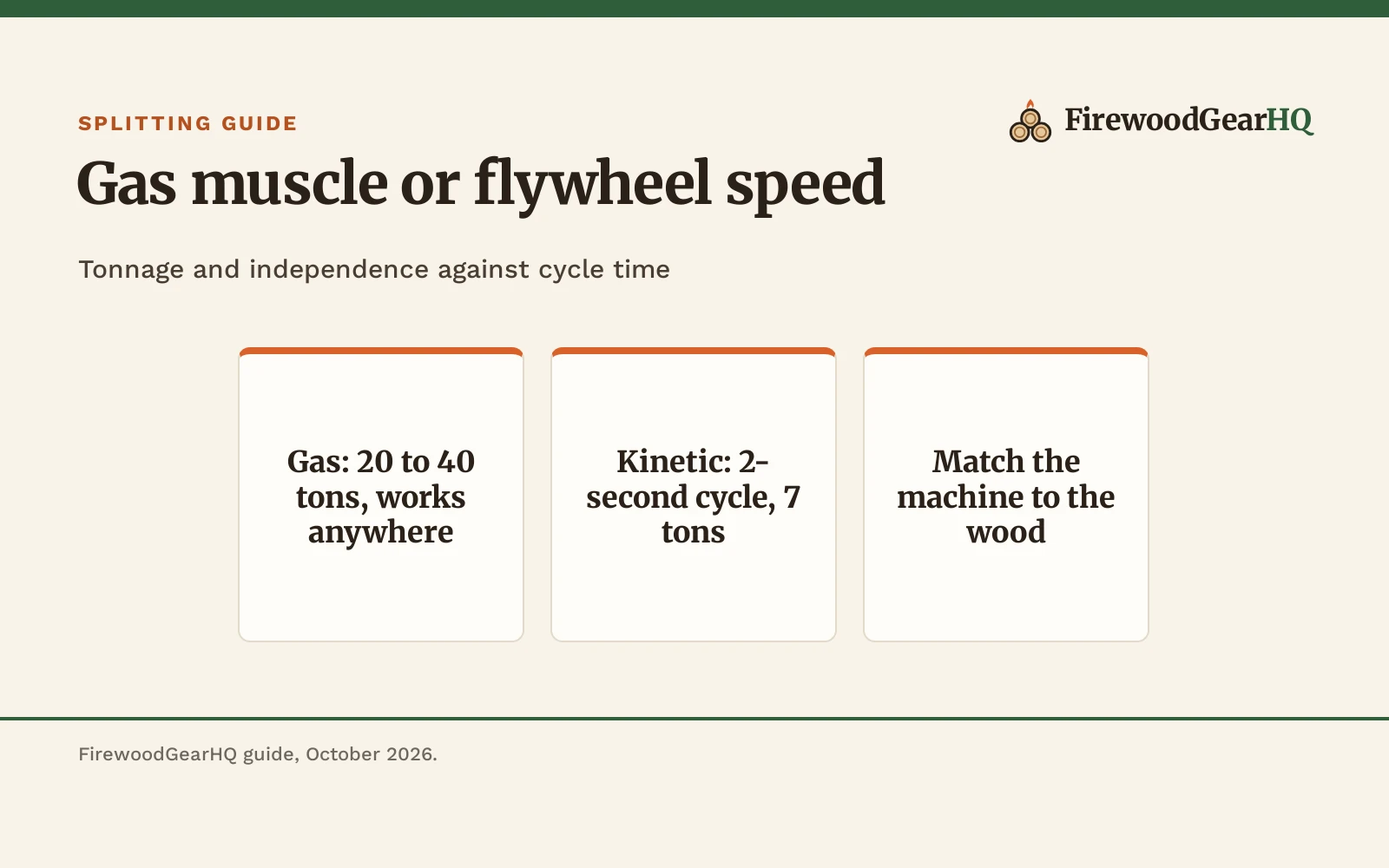
Gas vs kinetic log splitter is the choice between steady hydraulic muscle and flywheel speed. A gas splitter pairs an engine with hydraulics for 20 to 40 tons of relentless force, at the cost of noise, fuel and weight. A kinetic splitter spins flywheels and releases the energy in one fast strike, cycling in about 2 seconds, but the kinetic example here is a 7-ton electric machine, not a gas one. Buy gas for big rounds and off-grid work; buy kinetic for fast, straight-grained splitting near an outlet.
FirewoodGearHQ may earn a small commission if you buy through links on this page. The price you pay stays the same. Read our affiliate disclosure.
The reference listings include gas hydraulic splitters from 20 to 40 tons, one kinetic splitter (the BouPower 7-ton double flywheel, electric), and manual and electric-hydraulic listings used for context. Every figure below comes from the listings cited by brand, and where no figure is available we explain without one.
Gas vs kinetic log splitter: the short answer
The gas side runs from the ZeHuoGe 20-ton with a 7 HP, 196 cc engine and an 8-second cycle at 133 lb, through the aaculpet 20-ton with a 209 cc engine and 8-second cycle at 132 lb, the BILT HARD 22-ton with a 209 cc engine and 7-second cycle at 274 lb, and the SuperHandy 25-ton at 245 lb, to the YARDMAX 40-ton with a Briggs and Stratton engine at 605.2 lb and the Titan Attachments 25-ton 3-point for tractors at 430 lb. The kinetic side is the BouPower 7-ton: a double flywheel design on 110 V, 2 HP and 16 amps, with a 2-second cycle, handling 18.5-inch logs up to 15 inches in diameter at 139.6 lb. Gas brings tonnage and independence; kinetic brings speed.
What a gas splitter gives you
Gas splitters are hydraulic machines with an engine instead of a cord. The ZeHuoGe pairs its 7 HP engine with a 2-stage hydraulic gear pump for 20 tons, splitting 20-inch logs up to 16 inches in diameter on an 8-second cycle, with 10-inch transport wheels at 133 lb. The aaculpet matches that formula: 209 cc, 7 HP, 20 tons, 20 by 18 inch capacity, 8-second auto return, a 0.74-gallon tank good for 2 to 3 hours, at 132 lb on 10-inch pneumatic tires. The BILT HARD steps to 22 tons with a 209 cc engine, a 14 GPM 2-stage pump, a 7-second cycle and 25.5 MPa of pressure at 274 lb, towable at up to 25 MPH on 13-inch wheels.
At the heavy end, the SuperHandy lists 25 tons at 245 lb, the Titan Attachments 25-ton runs off a Category 1 tractor’s hydraulics at 430 lb with horizontal and vertical operation, and the YARDMAX 40-ton pairs a Briggs and Stratton XR1450 engine with a patent-pending U-beam, 26.5-inch log capacity and horizontal-to-vertical conversion at 605.2 lb. Gas means no outlet, steady force on knotty wood, and the freedom to work the woodlot; it also means fuel, oil, exhaust and noise, and weights from 132 to 605.2 lb.
What a kinetic splitter gives you
A kinetic splitter stores energy in spinning flywheels and releases it in one strike. The BouPower listing is the only kinetic machine here: a double flywheel design on a 110 V, 60 Hz, 2 HP, 16 amp motor drawing 1760 watts, with a 2-second cycle time and 7 tons of force, handling logs up to 18.5 inches long and 15 inches in diameter at 139.6 lb. Two seconds against 7 or 8 seconds is the whole argument: on straight-grained wood, a kinetic machine processes a pile dramatically faster than a hydraulic one.
The limits are the physics. Seven tons is modest next to the 20 to 40 tons of the gas listings, so knotty, twisted or very large rounds are not its job. It is also electric, running on 110 V, so it needs an outlet and stays near the house or barn. Kinetic suits the homeowner with straight wood and a big pile to move; it does not replace a gas splitter for the tough stuff.
Gas vs kinetic compared
| Feature | Gas splitter | Kinetic splitter |
|---|---|---|
| How it splits | Engine-driven hydraulics, steady push | Flywheels release energy in one strike |
| Force cited | 20 to 40 tons | 7 tons |
| Cycle time cited | 7 to 8 seconds | 2 seconds |
| Power | Gas engine, 196 to 209 cc; or tractor hydraulics | 110 V electric, 2 HP, 16 A |
| Log size cited | Up to 26.5 in long, 18 in diameter | 18.5 in long, 15 in diameter |
| Weight cited | 132 to 605.2 lb | 139.6 lb |
| Fuel and noise | Gasoline, exhaust, engine noise | No fuel; motor hum |
| Best for | Big rounds, knotty wood, off-grid | Fast splitting of straight wood near power |
Which one should you buy?
Buy gas if you heat with wood, process large or knotty rounds, or work away from power. The 20-ton ZeHuoGe or aaculpet cover the homeowner; the 25-ton SuperHandy or Titan 3-point cover the farm; the 40-ton YARDMAX covers the serious woodlot.
Buy kinetic if your wood is straight-grained, your pile is big, and you have an outlet. The BouPower’s 2-second cycle makes volume splitting dramatically faster on straight wood.
Consider the 3-point if you already own a Category 1 tractor: the Titan Attachments 25-ton borrows the tractor’s hydraulics, so there is no engine to maintain at all.
Common mistakes to avoid
- Expecting kinetic speed on knotty wood. The 2-second cycle assumes the wedge goes through. Twisted grain stalls a 7-ton strike; the 20 to 40 tons of the gas listings keep pushing.
- Buying tonnage you will never use. A 40-ton, 605.2 lb machine for a fireplace is overkill to buy, fuel and store. Match the tons to the wood, not the ego.
- Forgetting the fuel math. The aaculpet’s 0.74-gallon tank runs 2 to 3 hours; plan refills for a long day. Gas splitting means gas cans, oil and maintenance.
- Ignoring where the power comes from. The kinetic BouPower needs 110 V at 16 amps. The gas machines need fuel and oil, not an outlet. Put the splitter where its power is.
Frequently Asked Questions
Is kinetic faster than gas?
Per the listings, yes on cycle time: 2 seconds for the BouPower kinetic against 7 to 8 seconds for the gas hydraulics. On straight wood that is a large throughput advantage; on knotty wood the gas tonnage wins.
Can a 7-ton kinetic splitter handle big rounds?
The BouPower is listed for 18.5-inch logs up to 15 inches in diameter. Bigger or knotty rounds belong to the 20 to 40 ton gas class.
Do gas splitters need a lot of maintenance?
They need what small engines need: fuel, oil changes and air filters. The Titan 3-point is the exception, running off the tractor’s hydraulics with no engine of its own.
How much gas does a splitter use?
The aaculpet lists a 0.74-gallon tank for 2 to 3 hours of operation. The other gas listings give no consumption figure; see our guide on how much gas a log splitter uses for the full picture.
Can I use a kinetic splitter off-grid?
The BouPower kinetic runs on 110 V, so it needs grid power or a generator sized for its 16 amp draw. True off-grid splitting is the gas machines’ territory.
Which is quieter?
The kinetic machine has no engine, only motor hum. Gas engines are the loud side of this comparison; the listings give no decibel figures, so treat it as a qualitative difference.
Related guides
Related: our electric vs kinetic log splitter, kinetic vs hydraulic log splitter, 3 point log splitter vs gas and how much gas a log splitter uses guides.