Axe vs Wood Splitter: Which One Should You Buy?
Axes and wood splitters compared on head weight, swing effort, log size, splitting speed and upkeep, with three examples from the listings we reviewed.

On this page
Top picks at a glance
As an Amazon Associate we earn from qualifying purchases.
- 1
 Fiskars X27 Super Splitting Axe 36"9.8/10View on Amazon
- 2
 Fiskars Pro IsoCore 6 lb Splitting Maul9.7/10View on Amazon
- 3
 Fiskars Pro IsoCore 8 lb Splitting Maul9.7/10View on Amazon
- 4
 KSEIBI 274178 Splitting Axe 36-Inch Wood Splitter ForgedView on Amazon
- 5
 Husqvarna Wood Splitting Axe S1600View on Amazon
- 6
 Fiskars A-Series Super Splitting Axe 36"View on Amazon
- 7
 Coleman Axe with Durable Steel Head & Non-Slip Grip HandleView on Amazon
- 8
 ESTWING Fireside Friend Splitting MaulView on Amazon
- 9
 KSEIBI 274150 Camping Hatchet Axe Durable Camping Hatchet forView on Amazon
Verdict: Choose an axe if you split straight-grained firewood rounds, prefer a sharper cutting bit that penetrates end grain cleanly, and want a tool that can also drive felling wedges. Choose a wood splitter if you regularly encounter knotty, twisted rounds or large trunk sections where a blunt wedge and heavy downward momentum are needed to force the wood apart.
As fall chores turn toward winter heating, rounds piled by the chopping block must be split and stacked before the snow flies. When deciding between an axe vs wood splitter, the right choice depends on your wood species, log diameter and the physical effort required for each swing. A splitting axe uses a tapered blade with a cutting bit to enter the end grain and divide wood fibers, while a heavy wood splitter or maul relies on blunt wedge mass to burst tough rounds apart on impact. This comparison examines how head weight, blade geometry and maintenance separate the two tool styles, using the specific listings we reviewed as concrete examples.
FirewoodGearHQ may earn a small commission if you buy through links on this page. The price you pay stays the same. Affiliate disclosure.
| # | Product | Woodlot Score | Buy |
|---|---|---|---|
| 1 |  COUNCIL TOOL 5 lb Single Bit Faller's Axe | 9.7/10 | Buy on Amazon |
| 2 |  Estwing 6 lb Wood Splitting Maul with 36-Inch | 9.5/10 | Buy on Amazon |
| 3 |  35.5" Splitting Axe, Wood Splitting Axe for Medium | 9.4/10 | Buy on Amazon |

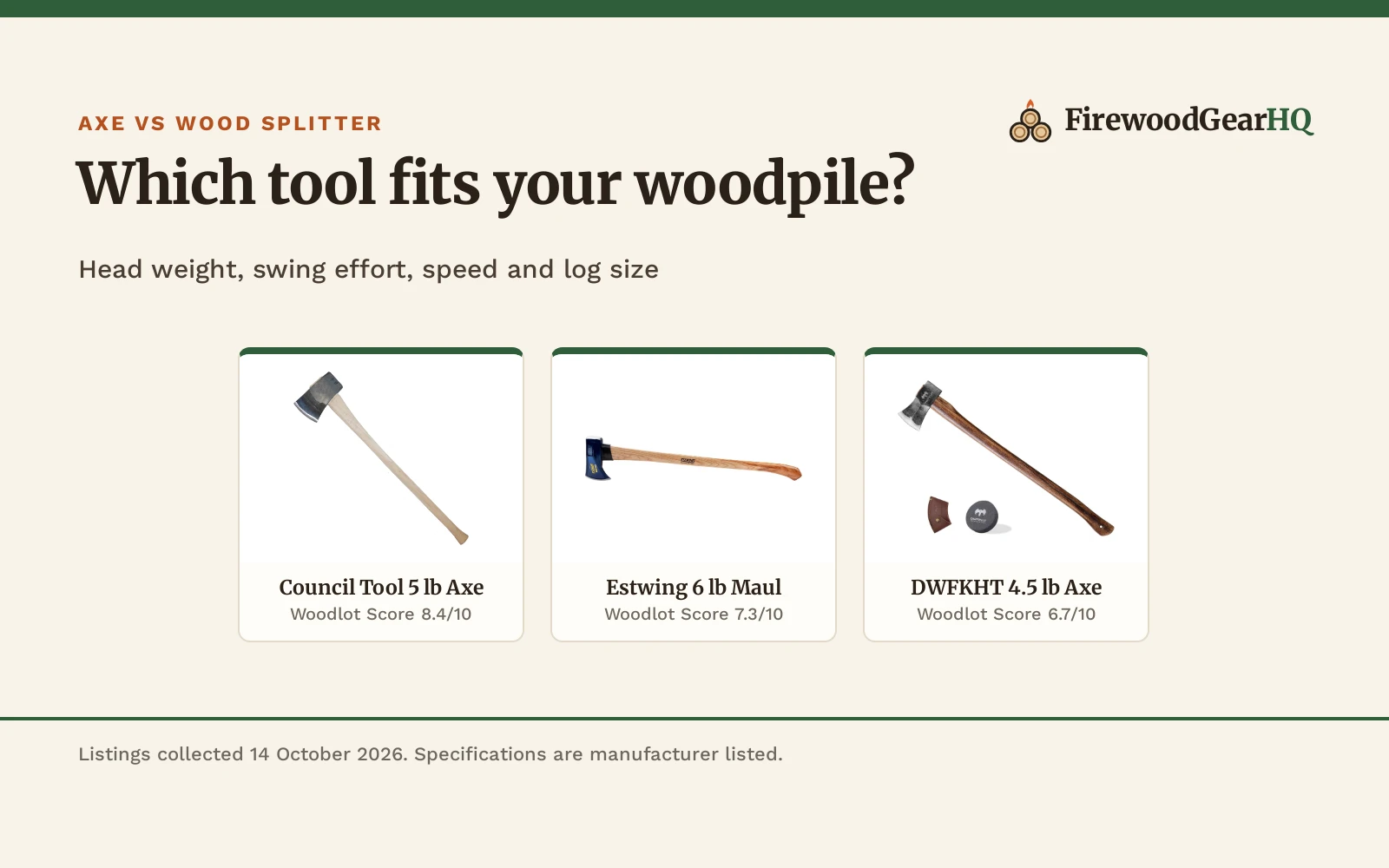
COUNCIL TOOL 5 lb Single Bit Faller's Axe
A 5 lb single-bit axe with a 36 in straight kiln-dried American hickory handle, forged tool steel head with 25 degree convex bevels at Rc 48-55, and chamfered poll corners.
Pros
- Forged tool steel head hardened to Rc 48-55 with 25 degree convex bevels
- Straight 36 in American hickory handle kiln-dried below 10 percent moisture
- Chamfered poll corners designed for driving plastic felling wedges
- Made in the USA with boiled linseed oil rust-resistant finish
Cons
- 5 lb head requires significant swing effort over long splitting sessions
- No sheath or blade mask included in the listing
- No warranty term is stated in the listing
- Felling-style head has narrower cheeks than a dedicated heavy splitting maul

Estwing 6 lb Wood Splitting Maul with 36-Inch
A 6 lb wood splitting maul with a 36 in contoured hickory handle, forged head hardened to 50 to 55 HRC, and a blunt splitting edge for stubborn firewood rounds.
Pros
- Forged maul head hardened to 50 to 55 HRC for impact resistance
- 36 in premium hickory handle provides substantial reach and leverage
- Blunt edge profile forces rounds apart without wedging tight
- Contoured lightweight grip designed for two-handed control
Cons
- Contradiction: listing title says 6 lb head while spec table lists 7.5 lb
- Heavy weight increases fatigue during extended splitting sessions
- No warranty term is stated in the listing
- Made in India with Groz listed as manufacturer in the spec table

35.5" Splitting Axe, Wood Splitting Axe for Medium
A 4.5 lb splitting axe with a 35.5 in handle, 1065 high-carbon forged steel wedge-shaped head, 6.3 lb total weight, and custom leather sheath included.
Pros
- 1065 high-carbon forged steel head with wedge-shaped splitting blade
- Includes a custom-made leather sheath for storage and transport
- 4.5 lb head weight is lighter to swing than heavier splitting mauls
- 35.5 in handle length provides good leverage on medium to large logs
Cons
- Contradiction: bullet lists beech wood handle while title and specs say hickory
- Listing has typos and lacks detailed metallurgical hardness specifications
- No warranty term is stated in the listing
- 4.5 lb head may require multiple strikes on tough, stringy hardwood
More options to compare
 KSEIBI 274178 Splitting Axe 36-Inch Wood Splitter ForgedCheck price on Amazon
 Husqvarna Wood Splitting Axe S1600Check price on Amazon
 Fiskars A-Series Super Splitting Axe 36"Check price on Amazon
 Coleman Axe with Durable Steel Head & Non-Slip Grip HandleCheck price on Amazon
 ESTWING Fireside Friend Splitting MaulCheck price on Amazon
 KSEIBI 274150 Camping Hatchet Axe Durable Camping Hatchet forCheck price on Amazon
Side by side
| Product | Side | Head weight | Handle length |
|---|---|---|---|
| Council Tool 5 lb Axe | Axe | 5 lb | 36 in |
| Estwing 6 lb Maul | Wood splitter | 6 lb | 36 in |
| DWFKHT 4.5 lb Axe | Axe | 4.5 lb | 35.5 in |
Ranges are typical of the listings we reviewed; example figures are manufacturer rated, collected 13 October 2026.
Axe vs wood splitter: head weight and splitting force
Head weight strongly influences how each tool delivers splitting force. An axe pairs head mass with swing speed so the cutting bit enters the wood cleanly before the blade cheeks force the grain apart. In our examples, the DWFKHT listing states a 4.5 lb head with a 6.3 lb total weight, while the Council Tool listing features a 5 lb forged tool steel head. By comparison, the Estwing wood splitter example lists a heavier 6 lb forged head in its title and bullets, though its spec table lists a 7.5 lb head weight. While the axe examples rely on a balance of swing velocity and bit penetration, the heavier wood splitter maul generates higher blunt impact momentum to split without needing maximum swing speed.
Blade profile and wedging action
The profile of the head determines how the tool interacts with wood grain. A splitting axe features a sharp cutting bit backed by tapered cheeks. In the Council Tool example, the listing states a wedge-shaped blade with a high centerline to reduce friction and prevent sticking, finished with 25 degree convex bevels hand-sharpened to Rc 48 to 55. The DWFKHT axe listing similarly describes a wedge-shaped blade with a sharp, thick edge to penetrate firewood rounds. In contrast, the Estwing wood splitter listing specifies a blunt blade edge. Rather than cutting into the grain, the blunt maul face acts immediately as an expanding wedge on impact, popping stubborn or knotty blocks apart where a sharper blade might bind.
Physical effort and swing fatigue
Physical effort on the woodpile depends on both tool weight and handle length. All three featured tools are heavy striking instruments that require steady stamina over an afternoon of splitting. The DWFKHT example, with its 4.5 lb head and 6.3 lb total weight, is the lightest of the trio and requires slightly less effort to reset between swings. The Council Tool example has a 5 lb head on a 36 in handle, which demands noticeable upper-body power during prolonged work. The Estwing wood splitter example, listed at 6 lb in the title and 7.5 lb in the spec table on a 36 in handle, requires the greatest physical exertion per strike. While that heavier maul head can bust knotty rounds with fewer swings, the user absorbs more fatigue than when working with the lighter axe listings.
Versatility and secondary tasks
Secondary capabilities vary between specific tool designs. The Council Tool axe listing highlights dual utility, noting it is designed for splitting wood and also doubles as a faller’s axe with chamfered poll corners for driving plastic felling wedges. The DWFKHT listing describes its splitting axe as an outdoor tool for firewood preparation, camp setup and shelter building. The Estwing wood splitter listing claims broad outdoor versatility for splitting, cutting and shaping wood, though its blunt blade edge profile is fundamentally built for impact splitting rather than fine cutting. For woodlot owners who fell trees, an axe with a wedge-driving poll provides utility that a dedicated splitting maul cannot match.
Upkeep, maintenance and storage
Both tool styles require routine maintenance to remain safe around the woodpile. Wood handles require inspection to ensure the head remains securely seated. The Council Tool listing notes its American hickory handle is kiln-dried below 10 percent moisture to prevent shrinkage and loosening, secured with a traditional wood and steel wedge, and coated with boiled linseed oil to resist rust. Cutting edge maintenance reflects the blade design: an axe with hand-sharpened 25 degree convex bevels like the Council Tool example requires edge care to retain sharpness, while a blunt-edged maul like the Estwing example is shaped for impact rather than a razor edge. For blade protection and transport, the DWFKHT listing includes a custom leather sheath, whereas the Council Tool and Estwing listings state no sheath is included.
Three examples
How we scored them
Each example is scored out of 10 on performance, build, value, safety and warranty, using only what the listing publishes. The weights are on our How We Pick page.
| Product | Woodlot Score | Perf. /35 | Build /25 | Value /25 | Safety /10 | Warranty /5 |
|---|---|---|---|---|---|---|
| Council Tool 5 lb Axe | 9.7 | 32 | 22 | 21 | n/a | 0 |
| Estwing 6 lb Maul | 9.5 | 28 | 19 | 19 | n/a | 0 |
| DWFKHT 4.5 lb Axe | 9.4 | 27 | 16 | 18 | n/a | 0 |
Scores run from 9.2 to 9.8: each product’s point total is placed on that range, so more points always means a higher score. Safety counts only for powered gear or where the listing states safety features; where it does not apply, the score is taken over the remaining 90 points.
Pick the wood species, the biggest round you split and its condition to get the splitter tonnage to shop for.
Clear the swing area (overhead too), split on a solid chopping block at a comfortable height, keep your feet apart with the block in front of you, and wear eye protection and sturdy boots. Replace a cracked or loose handle before you swing again. Read our Safety Disclaimer.
Around the Woodpile
- Maintain a clear swing zone around the chopping block, keeping bystanders and pets well outside your swing radius.
- Inspect hickory handles regularly for tightness and check that wedges remain secure before swinging.
- Use a protective leather sheath or edge cover during storage and transport to protect the blade and prevent accidental contact.
- When driving plastic felling wedges, use an axe poll with chamfered corners to prevent damage to the wedge and avoid steel mushrooming.
Frequently Asked Questions
Is a log splitter worth it compared to an axe?
A powered log splitter is worth the investment if you split high volumes of firewood each year or frequently tackle knotty rounds that resist hand tools. For smaller woodpiles of straight-grained wood, an axe or manual splitting maul costs nothing in fuel, requires minimal upkeep, and handles routine firewood tasks effectively.
What makes an effective log splitting axe?
An effective splitting axe combines a sharp cutting bit with tapered, wedge-shaped cheeks that push wood fibers apart on impact. The head profile reduces friction to prevent the blade from sticking in the cut, while a long hickory handle provides reach and leverage. The Council Tool example illustrates this balance with a forged tool steel head, 25 degree convex bevels and a kiln-dried American hickory handle.
How many tons should a log splitter be?
The required tonnage depends on the wood species, log diameter and whether the wood is green or seasoned. Straight-grained, seasoned wood requires far less hydraulic force than knotty, green hardwood. Rather than guessing, size your machine by consulting our tonnage guide to match hydraulic force to your firewood needs.
Which tool is better for splitting firewood, an axe or a maul?
An axe is generally better for straight-grained rounds where a sharp bit can enter cleanly and split the block with good swing speed. A wood splitter maul is better suited for knotty, stubborn rounds where a blunt, heavy wedge is needed to burst the wood apart through impact rather than cutting.
Related guides
See the axes and mauls hub, the log splitter hub, the best splitting axe guide, the best splitting maul guide and how to split wood with an axe.