Stump Vise for Chain Saw Sharpening (2026): 5 Field Vises Compared
Five stump vises for chain saw sharpening compared by material, listed weight, bar grip and warranty, from drop-forged cast iron to compact field tools.

On this page
Top picks at a glance
As an Amazon Associate we earn from qualifying purchases.
- 1
 Best OverallForester 7in Stump Vise9.5/10View on Amazon
- 2
 Best with Stated WarrantyTimber Tuff Stump Vise9.4/10View on Amazon
- 3
 Best Compact SteelQWORK Stump Vise9.4/10View on Amazon
- 4
 Best Simple SetupMaxPower Filing Vise9.3/10View on Amazon
When fall cutting starts or spring bucking fills the wood yard, nothing slows a firewood session faster than dull chain cutters dragging through hardwood. Touching up cutters on a tailgate or balancing a saw across a log round leaves the guide bar loose and rocking with every file stroke. Using a dedicated stump vise for chain saw sharpening turns any solid tree stump or cut log round into a stable field workstation, clamping the guide bar firm so you can keep your filing angles consistent.
FirewoodGearHQ may earn a small commission if you buy through links on this page. The price you pay stays the same. Affiliate disclosure.
Quick picks
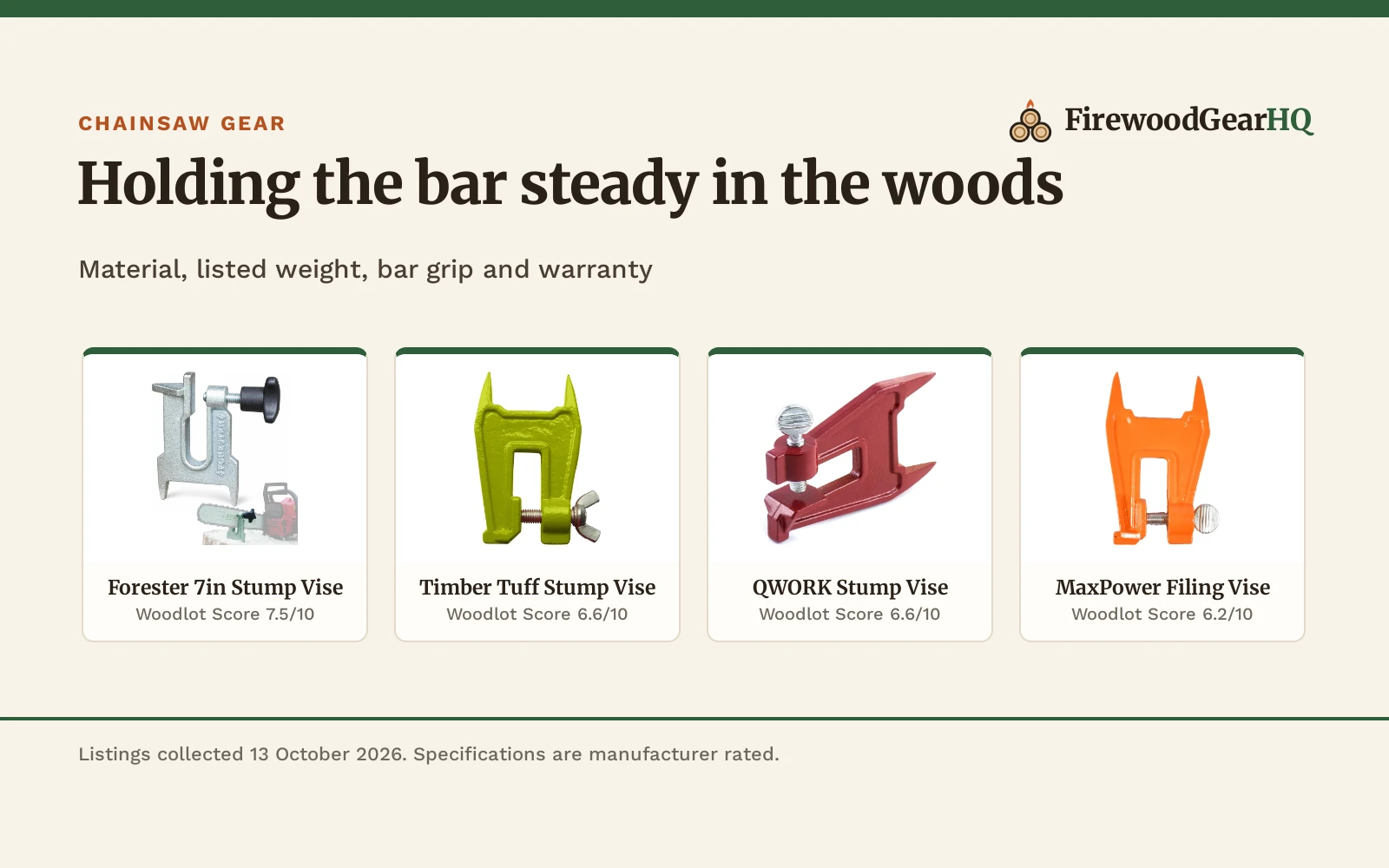
- Best Overall Forester 7in Stump Vise: Drop-forged cast iron 7 in vise with sharp steel forks that anchor firmly into stumps. Check price on Amazon
- Best with Stated Warranty Timber Tuff Stump Vise: Lightweight steel construction in hi-vis green backed by a stated 1 year parts warranty. Check price on Amazon
- Best Compact Steel QWORK Stump Vise: Hard steel vise with thumb screw adjustment and a listed weight of 1.06 lb. Check price on Amazon
- Best Simple Setup MaxPower Filing Vise: Filing vise with 13.3 oz listed weight and no assembly required for field chain care. Check price on Amazon
The picks

Forester Heavy Duty 7” Stump Vise for Chainsaw
A 7 in drop-forged cast iron stump vise with sharp steel forks and a built-in jaw for field chainsaw filing.
Pros
- Drop-forged cast iron construction built for impact resistance
- Sharp steel forks designed to drive into stumps or logs
- Built-in jaw designed to grip the chainsaw guide bar firmly
- Compact 7 by 2.25 by 3.75 in stated dimensions
Cons
- Item weight is not stated in the listing
- No warranty term is stated
- Takes hammer or maul strikes directly on cast iron
- Bulky to carry in a pocket compared to smaller models

Timber Tuff Portable Chainsaw Stump Vise
A lightweight steel stump vise in high-visibility green with a stated 1 year parts warranty for on-site chain filing.
Pros
- 1 year manufacturer parts warranty stated on defects
- High-visibility green color stands out among woodlot tools
- Lightweight steel construction designed to tap into logs
- Compact design engineered for portable field maintenance
Cons
- Spec table lists item weight as 1.44 oz, an apparent error for a metal vise
- Warranty covers parts only with no labor included
- Listing claims versatile sharpening for axes and shears on a bar clamp
- Dimensions are not stated in the listing

QWORK Chainsaw Stump Vise
A 1.06 lb hard steel chainsaw stump vise with an adjustable thumb screw and paint-coated finish for field sharpening.
Pros
- Made of hard steel with a paint-coated anti-corrosion finish
- 1.06 lb listed weight provides solid field heft
- Thumb screw design adjusts to fit all chain and bar sizes
- Pushes directly into stumps, logs or wood cuts
Cons
- No warranty term is stated in the listing
- Item dimensions are not stated; package is 5.87 x 4.02 x 1.06 in
- Painted finish can chip under hammer blows
- Forks require firm wood to anchor securely

MaxPower 336588 Chainsaw Filing Vise
A 13.3 oz portable filing vise with locking teeth and no assembly required for chainsaw chain maintenance in the field.
Pros
- 13.3 oz listed item weight balances portability and stability
- Clear dimensions published at 7.38 by 4.75 by 1.38 in
- No assembly required right out of the box
- Teeth dig securely into wood surfaces to stabilize the bar
Cons
- Material type is not stated in bullets or spec table
- No warranty term is stated
- Listing contains minimal detail and a typographical error
- Color and finish are not stated

Oregon Filing Vise Pocket Stump Vise for Filing
A compact pocket filing vise with sharp forks and guide bar lock designed for field maintenance on chainsaws and pole saws.
Pros
- Sharp forks drive into any stump for field stability
- Locks any chainsaw guide bar securely for filing
- Bullets state a pocket-friendly 7 by 5 in size
- Established forestry brand with 0.3 kg listed weight
Cons
- Spec table lists Material Type as Plastic with 500 psi tensile strength
- Spec table lists 17.5 x 6.75 x 5.1 in, contradicting the 7 x 5 in pocket size
- No warranty term is stated
- Red finish will show wear from hammer strikes
Compare the picks
| Model | Woodlot Score | Material | Dimensions | Weight (listed) | Color | Warranty (stated) |
|---|---|---|---|---|---|---|
| Forester 7in Stump Vise | 9.5/10 | Cast iron | 7 x 2.25 x 3.75 in | Not stated | Silver | Not stated |
| Timber Tuff Stump Vise | 9.4/10 | Metal | Not stated | 1.44 oz | Green | 1 year parts |
| QWORK Stump Vise | 9.4/10 | Hard steel | 5.87 x 4.02 x 1.06 in (package) | 1.06 lb | Red | Not stated |
| MaxPower Filing Vise | 9.3/10 | Not stated | 7.38 x 4.75 x 1.38 in | 13.3 oz | Not stated | Not stated |
| Oregon Filing Vise | 9.2/10 | Plastic (spec table) | 7 x 5 in (bullets) | 0.3 kg | Red | Not stated |
Specifications are manufacturer rated, collected 13 October 2026. Tool weights and dimensions are as listed and vary between standalone items and package packaging. Only one listing states a manufacturer warranty term.
How we scored them
Each vise is scored on performance, build, value, safety and warranty, using only facts the manufacturer publishes in the listing. Scoring weights and criteria details are on our How We Pick page.
| Product | Woodlot Score | Perf. /35 | Build /25 | Value /25 | Safety /10 | Warranty /5 |
|---|---|---|---|---|---|---|
| Forester 7in Stump Vise | 9.5 | 32 | 22 | 21 | 0 | 0 |
| Timber Tuff Stump Vise | 9.4 | 28 | 16 | 19 | 0 | 3 |
| QWORK Stump Vise | 9.4 | 28 | 20 | 20 | 0 | 0 |
| MaxPower Filing Vise | 9.3 | 27 | 18 | 18 | 0 | 0 |
| Oregon Filing Vise | 9.2 | 27 | 14 | 16 | 0 | 0 |
Scores run from 9.2 to 9.8: each product’s point total is placed on that range, so more points always means a higher score.
Choosing a stump vise for chain saw sharpening
Forks and stump anchoring
A field filing vise relies on sharp tapered forks that penetrate wood fibers to establish a solid base. Stouter forks forged from steel or cast iron withstand repeated mallet or axe-poll strikes without bending. When setting up in the field, pick a sound, level stump or heavy bucked round rather than rotten wood that crumbles under filing pressure. Drive the forks straight into the wood until the vise body rests solid against the surface.
Guide bar clamping mechanism
The clamping jaw holds the guide bar rigid while allowing the chain to roll freely along the bar rails. Most models use a threaded thumb screw or lever that tightens against the bar body behind the nose sprocket. The clamp needs enough grip to resist forward filing pressure while leaving sufficient clearance so cutters clear the jaw as you advance the chain by hand.
Material and tool weight
Stump vises face tough conditions: damp forest soil, direct hammer strikes and heavy metal files. Drop-forged cast iron and hard steel offer rugged resilience against cracking, though they carry extra weight in a field pouch. Lighter designs are easier to pack on long walks across a woodlot, but they must still provide enough mass to keep the bar from wobbling under stroke pressure.
High-visibility finish and woodlot contrast
Small metal tools easily disappear into leaf litter, bark piles and sawdust when setting up a field sharpening station. Timber Tuff uses a bright green paint finish specifically designed to stand out against wood chips and brush, while Oregon and QWORK coat their steel bodies in red. Choosing a vise with a vibrant contrasting color makes the tool quick to spot when packing up gear at dusk, whereas bare silver or dark finishes can blend into forest duff if laid down between cutting rounds.
Filing clearance and tooth advancement
A proper field clamp must grip the bar firmly without pinching the drive links in the bar groove. Position the clamping jaws along the flat body of the guide bar, clear of the bar nose sprocket and oiler hole. Once the clamping screw or thumb screw is tightened against the bar, verify that the chain pulls smoothly along the rails so you can advance each cutter into position for filing without loosening the clamp between teeth.
Listing accuracy and specifications
Online tool listings for field accessories frequently contain clerical errors, including conflicting dimensions or omitted weight figures. When comparing models, verify whether stated measurements represent the tool itself or the shipping package, and check whether stated materials align with heavy striking duties.
Wear eye protection and gloves for cutting, splitting and handling, follow every tool's manual, install stoves to code, and have the chimney inspected and cleaned every year. See EPA Burn Wise and NFPA heating safety. Read our Safety Disclaimer.
Around the Woodpile
- Drive vise forks into solid, sound wood using a wooden mallet or the flat poll of a splitting tool, avoiding glancing blows that could damage the clamping screw.
- Wipe wood chips and filing grit off the clamping jaw and screw threads before slipping the tool into a pouch to keep the threads turning smoothly.
- Tighten the clamping jaw firmly against the guide bar body, leaving the chain free to rotate along the bar groove as you advance each tooth.
- Store the vise in a dry gear bag or belt pouch between woodcutting sessions to protect the steel forks and threaded hardware from damp weather.
Frequently Asked Questions
What is a stump vise?
A stump vise is a compact, portable clamping tool designed for field chainsaw maintenance. It features pointed forks that drive into a tree stump or log round, anchoring a built-in jaw that grips the chainsaw guide bar firmly while you file the cutters.
How does a stump vise work?
The tool works by turning an immovable stump into a sturdy workbench in the woods. Once the forks are tapped into the wood, the vise holds the saw bar upright and rigid, preventing the saw from shifting so each cutter tooth can be filed at a consistent angle.
How to use chainsaw stump vise?
Find a solid, level tree stump or heavy log round near your cutting area. Drive the pointed forks into the wood using a mallet or axe poll until anchored. Place your chainsaw guide bar into the clamping slot, tighten the thumb screw against the bar, and file your chain cutters, advancing the chain by hand as you work.
Do you need a workbench in the woods to sharpen a chainsaw?
No. A stump vise eliminates the need for a dedicated workbench by using stumps and bucked logs already on site. It provides steady bar support right where you cut firewood, saving trips back to the workshop.
Related guides
Explore our chainsaw gear section and the main chainsaws hub for more woodlot tools. To pair your filing vise with dedicated files and depth gauge tools, browse our guide to the best chainsaw sharpener. If you are timing maintenance stops during firewood bucking, learn how often should you sharpen a chainsaw chain. Uneven filing can cause bar drift; see why does my chainsaw cut crooked for troubleshooting steps. Selecting replacement loops? Review what chainsaw chain do i need. For personal protection in the timber, check the chainsaw safety gear checklist, pair your work with the best chainsaw chaps, and protect your hands with the best chainsaw gloves. Keep your guide bar running cool with the best bar and chain oil, and find the right saw for cutting cords in our roundup of the best chainsaw for firewood.