30cc vs 40cc Chainsaw: Which One Should You Buy?
30cc vs 40cc chainsaw: what engine size changes, which bar length suits firewood, and three saws that show the range, ranked by stated specs.

On this page
Top picks at a glance
As an Amazon Associate I earn from qualifying purchases.
- 1
 Husqvarna 460 Rancher Gas Powered Chainsaw9.7/10View on Amazon
- 2
 Greenworks 40V 16" Brushless Cordless Chainsaw9.7/10View on Amazon
- 3
 WORX Cordless Chainsaw9.6/10View on Amazon
Fall cutting season is here, and the woodpile is waiting on a saw that can keep up with the rounds. Here is the short answer to 30cc vs 40cc chainsaw: a 40cc-class saw pulls harder through bigger wood, while a 30cc-class saw is lighter and easier to handle for limbing and lighter cutting. Pick the engine that matches the wood you cut most, not the biggest number on the shelf.
FirewoodGearHQ earns a small commission if you buy through links on this page. The price you pay stays the same. Read our affiliate disclosure.
30cc vs 40cc chainsaw: the quick answer
A 40cc-class saw cuts faster through larger rounds and handles storm-felled trees with less bogging down. A 30cc-class saw weighs less, which suits limbing, pruning and small firewood where a light saw is easier to carry and control. If most of your cutting is bucking firewood rounds at home, a saw in the 40cc class with a mid-length bar is the common choice; if you mostly limb and trim, the smaller class saves your arms.
What engine size actually changes
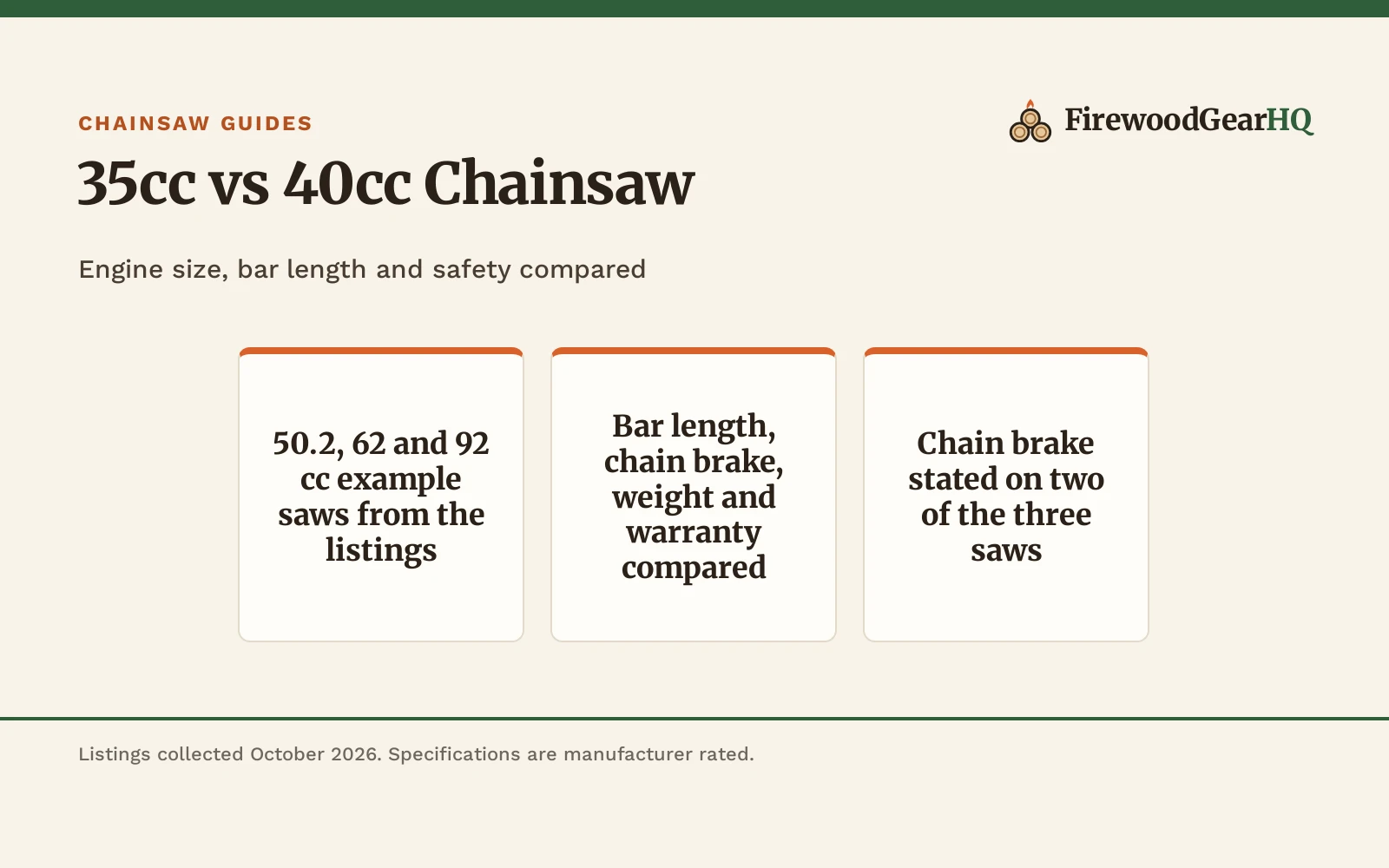
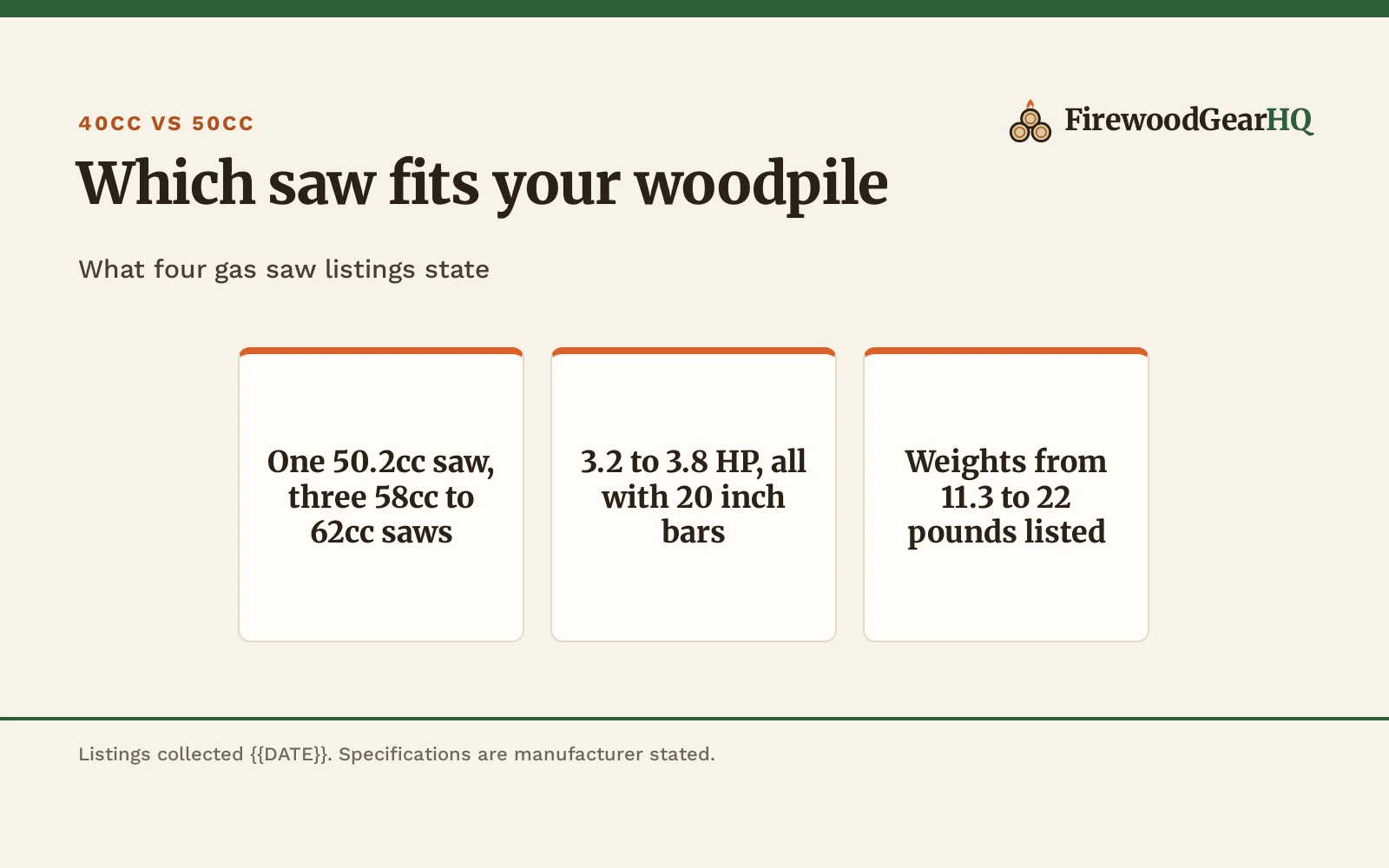
Displacement is the size of the engine, and in these listings it tracks closely with power: the VEVOR lists a 62cc engine making 3.8 HP with a maximum speed of 12000 RPM, the Husqvarna 450 Rancher lists a 50.2-cc, 3.2-HP X-Torq engine, and the WORKIT lists a 25.4cc engine making 1.2 HP. More power means the chain keeps its speed in the cut instead of bogging, which is why the VEVOR listing claims fast cutting through hardwoods such as oak and maple.
Bigger is not automatically better. A larger engine usually weighs more, and its extra power is wasted on limbing work where a light saw shines. Match the engine to the wood: heavy rounds and land clearing reward displacement, while pruning and light cutting reward light weight.
Bar length and the wood in front of you
The bar has to reach through the wood you cut. The Husqvarna listing recommends bar lengths between 13 inches and 20 inches and ships with a 20 inch bar, and the VEVOR ships with a 20 inch bar that the listing says can cut logs up to 17.9 inches. The WORKIT carries a 12 inch bar aimed at pruning, confined spaces and precision cutting.
A bar much longer than the wood adds nose weight and drag without helping the cut; a bar shorter than the log forces double cutting from both sides. For general firewood bucking, a bar in the mid range of what the saw supports is the easy choice, and the Husqvarna’s 13 to 20 inch recommendation shows how wide that range can be on one saw.
Weight matters on a long cutting day
Chainsaw weights in this guide run from 8.2 pounds on the WORKIT to 11.3 pounds on the Husqvarna item weight line, up to 16.5 pounds on the VEVOR. A few pounds sounds small until the third hour of cutting, when a heavy saw drags on every lift and set-down. If your cutting sessions run long, weight deserves as much attention as displacement.
Three saws that show the range
These three saws from the listings, ranked by score, show what each engine class looks like in practice.
Husqvarna 450 Rancher: the firewood workhorse
The Husqvarna 450 Rancher scored highest here. The listing describes a 50.2-cc, 3.2-HP X-Torq engine with a 20 inch bar, Smart Start for easier starting, an inertia-activated chain brake that reduces the likelihood of injury from kickback, a centrifugal air cleaning system and LowVib technology, with a 2 year manufacturer warranty. It is listed for tree pruning, yard cleanups and firewood cutting.
One caution: the listing’s spec table disagrees with the title, giving 40.9 cc, 2.2 HP, a 16 inch bar and 9.78 pounds against the title’s 50.2-cc, 3.2-HP, 20 inch bar and the 11.3 pound item weight. Trust the title and bullets over the spec table. The saw for: regular firewood cutting where a proven mid-size saw earns its keep. Skip it if: the listing’s internal disagreement bothers you, or you want the lightest saw here.
VEVOR 62CC: the heavy hitter
The VEVOR scored second. The listing describes a 62cc engine making 3.8 HP at up to 12000 RPM, a 20 inch bar that cuts logs up to 17.9 inches, starting in about 9 seconds with a throttle-synced choke, a 40:1 fuel-to-oil mixing ratio, a guard plate and switch to reduce the risks of accidental activation and kickback, and a weight of 16.5 pounds. It is positioned for wood cutting, tree trimming and land clearing, including storm-felled trees and winter firewood.
The saw for: big rounds, storm cleanup and anyone who wants the most displacement of the three. Skip it if: you carry the saw far or cut for hours, since 16.5 pounds is the heaviest figure here, and no warranty term is stated.
WORKIT 25.4CC: the light top-handle
The WORKIT scored third. The listing describes a 25.4cc top-handle saw with a 12 inch bar, 1.2 HP, an 8.2 pound weight, a chain brake, dual safety locks, a protective baffle, an auto oiler and a 3/8 pitch, 0.050 inch gauge chain with 45 drive links. The box includes a bar cover, an empty pre-mix oil jug, an assembly tool kit, a spare spark plug, a gasket, manuals, gloves, safety goggles and earplugs.
The saw for: limbing, pruning and tight spots where a light, nimble saw matters, with the most complete accessory bundle of the three. Skip it if: your main job is bucking big firewood rounds, which wants more displacement.
Safety gear is part of the saw
A chainsaw purchase is not complete without the gear: chaps, a helmet with a face screen and hearing protection, gloves and boots, and a habit of never cutting alone. Two of the three saws here state a chain brake, and the WORKIT bundle even includes gloves, goggles and earplugs. Read the owner’s manual for the saw you buy, and keep the chain sharp, since a dull chain forces the cut and raises the risk. See our chainsaw chaps guide and chainsaw gloves guide for the gear side.
Wear cut-resistant chaps, a helmet with face screen and hearing protection, gloves and sturdy boots. Know where the kickback zone is (the upper tip of the bar), keep the chain brake working and the chain sharp, and never cut alone in the woods. Felling trees is hazardous work: hire a professional for large, leaning or storm-damaged trees, especially near buildings or power lines. See OSHA logging safety for chain saw operators. Read our Safety Disclaimer.
FAQ: wood, fire and gear
Is a 40cc chainsaw enough for firewood?
For typical firewood bucking, yes. The Husqvarna 450 Rancher at 50.2-cc is listed for firewood cutting, and a mid-size saw like it handles household rounds well. The listings here include no 40cc saw, so treat the Husqvarna as the closest example. Step up to a larger saw only if you regularly cut large or storm-felled trees.
What bar length do I need for firewood?
Match the bar to the wood. The Husqvarna listing recommends 13 to 20 inch bars, the VEVOR’s 20 inch bar cuts logs up to 17.9 inches per the listing, and the WORKIT’s 12 inch bar suits pruning and small cutting.
How much does a gas chainsaw weigh?
The listings here range from 8.2 pounds on the WORKIT to 11.3 pounds on the Husqvarna item weight line and 16.5 pounds on the VEVOR. Lighter saws tire you out slower on long cutting days.
What safety gear should I wear with a chainsaw?
Chaps, a helmet with a face screen and hearing protection, gloves and boots, and never cut alone. The Husqvarna and WORKIT listings both state a chain brake, which reduces the likelihood of injury from kickback.
Can a small chainsaw cut hardwood?
The listings say yes, with limits. The VEVOR listing claims fast cutting through oak and maple at 62cc and 3.8 HP, and the WORKIT listing claims strong performance cutting hardwood at 25.4cc. Hard, large hardwood rounds still favor the bigger engine.
More firewood guides
See the best chainsaw for firewood, the best chainsaw sharpener and the best chainsaw chain for hardwood. Cutting your own? Start with the right bar in our chainsaw chain guide.