Wood Burning Fireplace Dimensions and Sizing Guide
Wood burning fireplace dimensions are the measurements of the opening, firebox, hearth and flue, and they decide whether a fireplace fits the wall and draws smoke up the chimney.

On this page
Top picks at a glance
As an Amazon Associate I earn from qualifying purchases.
- 1
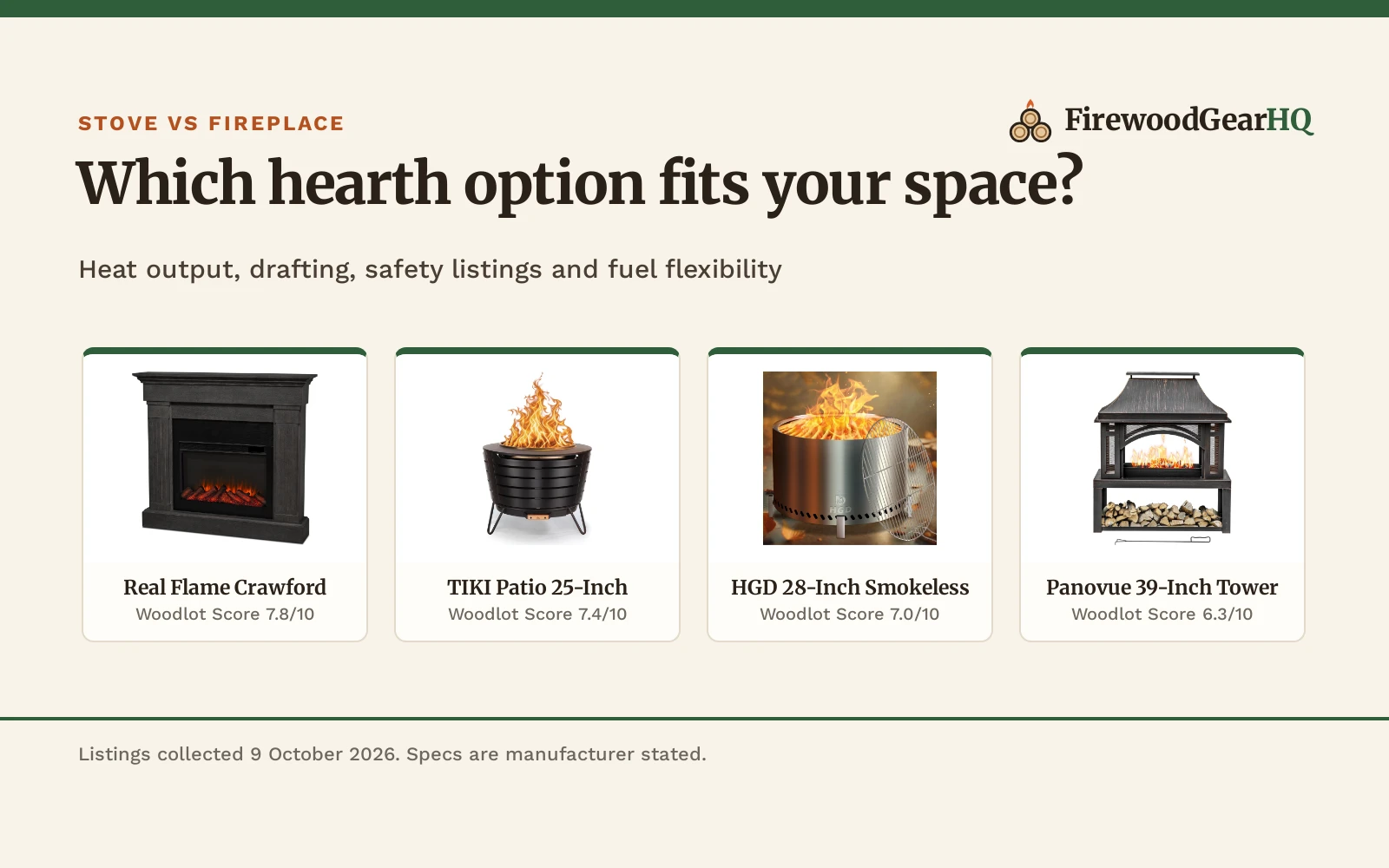
 TIKI Patio 25-Inch Smokeless Outdoor Wood Burning Fire Pit9.3/10View on Amazon
- 2
 HGD 27" Smokeless Fire Pit with Stand & Grill Rack9.2/10View on Amazon
- 3
 Panovue 39 Inch Fire Pits with Outdoor Chimney and Wood9.0/10View on Amazon
Fall brings the wood inside and the fire back to the hearth, and a fireplace that fits the room starts with a tape measure, not a catalog photo. Wood burning fireplace dimensions are the measurements of the opening, the firebox, the hearth and the flue, and they decide whether a fireplace fits the wall and draws smoke up the chimney. This guide walks through what to measure, how the parts relate, and what to check before ordering.
FirewoodGearHQ earns a small commission if you buy through links on this page. The price you pay stays the same. Read our affiliate disclosure.
The quick answer
Measure the opening, the firebox, the hearth and the flue before you shop. The opening sets the size of the fire you can see and tend, the firebox sets the size of the fire you can build, the hearth protects the floor in front, and the flue carries the smoke out. Match the fireplace to the room and the chimney, and check the maker’s manual and local code for clearances and inspection before the unit goes in.
Wood burning fireplace dimensions: what to measure
Every fireplace has the same parts to measure, whether it is built of brick or bought as a factory unit. Measure each part at several points, because walls and openings are rarely square, and write down the smallest figure you find for each part.
| Part | What to measure | Why it matters |
|---|---|---|
| Opening width | Across the front of the firebox, wall to wall | Sets the size of the fire and the view |
| Opening height | From the hearth to the lintel above | Sets the size of the fire and the mantel fit |
| Firebox depth | From the opening to the back wall | Sets how deep the fire can sit |
| Firebox width | Across the back wall of the firebox | Sets the log length the firebox takes |
| Hearth depth | From the opening out across the floor | Protects the floor in front of the fire |
| Hearth width | Across the front, past the opening at each side | Protects the floor at the sides of the fire |
| Flue size | The passage inside the chimney | Carries smoke out and sets the draw |
| Overall size | The whole unit, width and height in the wall | Decides whether the unit fits the wall |
Measure the opening at the top, the middle and the bottom, because an opening can be wider at the hearth than at the lintel. Use the smallest figure for each measurement when you compare units, so a tight spot does not catch you out.
Write the figures down with a sketch of the wall, the hearth and the chimney, and keep the sketch with you when you shop. A sketch keeps the opening, firebox, hearth and flue figures together, so a unit that fits the opening but not the flue does not slip through.
How the firebox size shapes the fire
The firebox is the chamber where the fire burns, and its size sets the size of the fire. A wide, deep firebox takes longer logs and a bigger fire, while a narrow, shallow firebox suits a smaller fire and a smaller room. The firebox and the flue work together: a firebox that is too large for its flue can smoke into the room, and a firebox that is too small for its flue can draw poorly.
Log length follows firebox width: a log should fit inside the firebox with room to spare at each end, so the wood lies flat and the fire burns evenly. Cut the wood to fit the firebox, not to the pile, and stack it where it stays dry until it burns.
The hearth and the clearances
The hearth is the floor in front of the fireplace, and it catches embers and heat that leave the opening. It must run in front of the opening and past it at each side, with no gaps in the surface. The clearances around the fireplace, the distances from the firebox to wood trim, walls and the mantel, follow the maker’s manual and local code, and a certified pro can confirm them before the unit goes in.
Keep smoke and CO alarms in the home, and have the chimney inspected each year. Burn seasoned wood only, because wet wood smokes, cools the fire and builds creosote in the flue.
Match the fireplace to the room
A fireplace that is too large for its room can overheat the space and leave the fire damped down, which smokes and builds creosote. A fireplace that is too small for its room leaves the corners cold and the fire working hard for little heat. Match the unit to the room it heats, the height of the chimney, and the wood you have on hand.
Think about the chimney as well as the room. A tall chimney draws harder than a short chimney, and a chimney that runs inside the house stays warmer than a chimney on an outside wall. The draw, the room and the firebox all pull in the same direction when the parts match.
Common mistakes to avoid
- Measuring the opening at the top only: measure at the top, the middle and the bottom, because an opening can vary from hearth to lintel.
- Forgetting the hearth: the hearth needs room in front of the opening and past it at each side, so measure it as part of the fireplace, not as an afterthought.
- Forgetting the flue: a firebox that does not match its flue can smoke or draw poorly, so check the flue size with the firebox size.
- Buying by looks alone: a unit that fits the eye can still miss the wall, the flue or the clearances, so compare the figures before you order.
- Skipping the manual and local code: clearances, inspection and permits follow the maker’s manual and local code, and a certified pro handles the install.
FAQ: wood, fire and gear
How do I measure a fireplace opening?
Measure across the front of the firebox for the width, from the hearth to the lintel for the height, and from the opening to the back wall for the depth. Measure at the top, the middle and the bottom, and use the smallest figure for each measurement.
What is the firebox?
The firebox is the chamber where the fire burns. Its width, height and depth set the log length and the size of the fire, and it must match the flue for the fireplace to draw well.
How big should the hearth be?
The hearth must run in front of the opening and past it at each side, with no gaps in the surface. The exact size follows the maker’s manual and local code, so check the manual and local code before you order.
Does the flue size matter?
Yes. The flue carries smoke out of the house, and it must match the firebox: a flue that is too small for its firebox can smoke into the room, and a flue that is too large can draw poorly. Check the flue size with the firebox size before you order.
Can I put a large fireplace in a small room?
A large fireplace can overheat a small room and leave the fire damped down, which smokes and builds creosote. Match the fireplace to the room it heats, and ask a certified pro if the room and the chimney suit the unit you have in mind.
Do I need a permit for a new fireplace?
Check local code before work starts: permits, clearances and inspection follow the maker’s manual and local code. A certified pro handles the install and can confirm what the code in your area requires.
More firewood guides
See the wood stoves hub, the best wood stove for heating a house, the wood stove BTU calculator and the wood stove pipe installation guide.