Round File vs Flat File: Which One Should You Buy?
Round file vs flat file for chainsaw sharpening: the round file sharpens the cutters, the flat file lowers the depth gauges.


On this page
Top picks at a glance
As an Amazon Associate we earn from qualifying purchases.
- 1
 PFERD Tools Chainsaw File Set9.7/10View on Amazon
- 2
 Husqvarna Chainsaw File Kit for 3/8" Pitch H Chainsaw Chains9.6/10View on Amazon
- 3
 Hipa 12 Pack Chainsaw File9.5/10View on Amazon
- 4
 TARIST Metal File SetView on Amazon
- 5
 WORKPRO 8 in. Half Round FileView on Amazon
- 6
 warmtree 3 pcs Metal File SetView on Amazon
- 7
 WORKPRO W051005 Round FileView on Amazon
- 8
 uxcell 5pcs Round Diamond Needles File 2mm x 100mm 150 GritView on Amazon
- 9
 Nicholson Round Hand File Without HandleView on Amazon
Round file vs flat file comes down to two different parts of the chain: the round file sharpens the cutters, the teeth that do the cutting, and the flat file lowers the depth gauges, the small rakers in front of each cutter that set how deep the tooth bites. You need both, in that order, because a sharp tooth with a tall gauge barely bites, and a low gauge with a dull tooth just rubs and overheats.
More options to compare
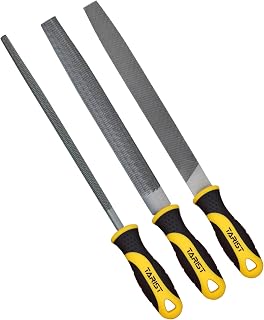 TARIST Metal File SetCheck price on Amazon
 WORKPRO 8 in. Half Round FileCheck price on Amazon
 warmtree 3 pcs Metal File SetCheck price on Amazon
 WORKPRO W051005 Round FileCheck price on Amazon
 uxcell 5pcs Round Diamond Needles File 2mm x 100mm 150 GritCheck price on Amazon
 Nicholson Round Hand File Without HandleCheck price on Amazon
FirewoodGearHQ may earn a small commission if you buy through links on this page. The price you pay stays the same. Read our affiliate disclosure.
The quick answer
Buy the round file for the cutters and the flat file for the depth gauges. The listings name the pairing plainly: the Oregon 12-pack is a dozen 7/32-inch (5.5mm) diameter saw chain files for 3/8 and .404 pitch chains, 10 inches long, built for the teeth. The flat file belongs in your kit for the depth gauges. Sets like the TARIST 3-piece, the warmtree 3-piece and the pwkauka 3-piece all ship flat, half-round and round files together in 8-inch lengths, because the workshop needs all three shapes.
What the round file does
The round file matches the curve of the cutter. Each tooth on the chain has a rounded gullet, and the round file restores the edge with a few strokes from the inside out. The Oregon listing is the reference here: a dozen 7/32-inch files, consistent tooth height, double-cut design that resists clogging and stays sharp, fitting both the standard file guide and the Sure Sharp bar-mounted filing guide. The listing works them on all chainsaw models with 3/8 and .404 pitch chains. The TARIST 10-inch round file is the rat-tail variant at 3/8 inch diameter in T12 carbon steel at 62 to 66HRC, and the WORKPRO W051005 is an 8-inch round file in high carbon hardened steel with a rubber grip handle, listed for forming and shaping holes and curves.
File every cutter the same number of strokes, and check your work against the smallest cutter: the chain is only as good as its worst tooth. The listings do not state stroke counts, so work by eye and by feel, not by a number.
What the flat file does
The depth gauge sits in front of each cutter and sets the bite. As the cutters get shorter with sharpening, the gauges stand relatively taller and need lowering with a flat file. The flat file rides across the top of the gauge, a few light strokes at a time. The pwkauka listing describes the job well: the flat face smooths sheet-metal edges in the shop, and on the chain it takes the gauge down evenly. Too low and the chain grabs and kicks; too high and it skims without cutting. The listings state no gauge heights, so this is feel work: lower a little, cut, and check.
Round file vs flat file: which does what
The two files never substitute for each other. The round file cannot flatten a depth gauge, and the flat file cannot reach into the cutter gullet. The half-round file, shipped in the TARIST, warmtree and pwkauka 3-piece sets, bridges the two: flat side for gauge work and flat surfaces, curved side for concave curves. The WORKPRO 8-inch half-round is sold on exactly that dual use, shapes, smooths, deburrs and refines edges, grooves, contours and curved surfaces. If you buy one set for the woodpile, the 3-piece flat, half-round and round combination covers the chain and the shop.
Matching the round file to the chain
Round file diameter must match the chain pitch. The Oregon 12-pack states 7/32 inch for 3/8 and .404 pitch chains, and that is the only pitch-to-file pairing any listing here states. The TARIST 10-inch round file is 3/8 inch diameter. Buy the diameter your chain calls for; a file too small rounds the gullet wrong and a file too large flats the edge. The listings do not state pairings for other pitches, so check your chain box or bar for the pitch before ordering.
File sets and what they include
The sets bundle the shapes with the accessories. The kapoua 6-piece ships flat, warding, square, triangular, round and half-round files in carbon steel at 3.84 ounces, with rubberized handles. The REXBETI 25-piece ships 4 large files at 200mm in flat, triangle, half-round and round, plus 12 needle files at 140mm, sandpaper, gloves, a wire brush and a carry case at 2.64 pounds, all in T12 drop forged alloy steel. The Hi-Spec 17-piece ships 4 full-length 12-inch machinist files and 12 needle files in heat-treated T12 high-carbon steel with a zipper case and wire brush. The TARIST, warmtree and pwkauka 3-piece sets ship 8-inch flat, round and half-round files in T12 at 62 to 66HRC, the warmtree at 13.4 ounces and the pwkauka at 15.5 ounces with a pouch.
For the woodpile, the 8-inch 3-piece sets are the sweet spot: full-size enough for chain work, small enough for the saw box. The big sets earn their keep in a shop that also files axes, mower blades and tools. See how to sharpen a splitting axe for the axe side of the same skill.
Filing order in the field
Work in order: round file on the cutters first, then the flat file on the depth gauges. Clamp the bar in a stump vise if you have one. File from the inside of the tooth outward, lifting on the return stroke so the teeth cut in one direction only. Keep the file level and steady; rocking it rounds the edge you are trying to keep crisp. After the cutters, lay the flat file across the depth gauges and take each down a few light strokes. Then cut wood and read the chips: thick curls mean the gauges are right, dust means the chain needs more work.
Caring for files
Files are consumables, but care stretches them. The TARIST and warmtree listings give the same two rules: a light touch of machine oil preserves the surface finish, and the file cannot accept being dropped, because the deeply quenched and coated teeth chip on impact. The REXBETI and Hi-Spec sets include a wire brush for clearing filings from the teeth; a clogged file skates instead of cutting. Store files so they do not knock together: the kapoua set has rubberized handles, the big sets ship in cases, and the pwkauka set comes with a pouch. When a file stops biting with light pressure, replace it; pressing harder just ruins the edge.
Frequently Asked Questions
Can I use a flat file on chainsaw teeth?
No. The cutters need the round file matched to the chain pitch; the flat file is for the depth gauges. The half-round file covers both flat and curved work in the shop.
What size round file does my chain need?
Match the diameter to the pitch. The Oregon listing states 7/32 inch for 3/8 and .404 pitch chains. The listings state no other pitch pairings, so check your chain for its pitch.
How do I know the depth gauges are right?
Cut wood and read the chips. Thick curls mean the gauges are right; fine dust means the chain is skimming and needs more work on the cutters or the gauges.
How long does a file last?
The listings state no lifespan. Oil the file lightly, never drop it, clean the teeth with a wire brush, and replace it when it stops biting under light pressure.
File or electric sharpener?
Files are quiet, cheap and precise in the field; electric sharpeners are faster at the bench. See electric chainsaw sharpener vs file for the full comparison.
Related guides
Also see how to use a stump vise and how often you should sharpen a chainsaw chain.