Poly vs Wire Chimney Brush: Which One Should You Buy?
Poly and wire chimney brushes compared for metal and masonry flues, with 4 examples from the listings we reviewed.

On this page
Top picks at a glance
As an Amazon Associate I earn from qualifying purchases.
- 1
 Midwest Hearth Poly Chimney Cleaning Brush9.5/10View on Amazon
- 2Midwest Hearth Poly Chimney Cleaning Brush9.4/10View on Amazon
- 3
 Midwest Hearth Wire Chimney Cleaning Brush9.3/10View on Amazon
- 4
 Midwest Hearth Wire Chimney Cleaning Brush9.2/10View on Amazon
Verdict: Choose a poly chimney brush if your flue is a metal stove pipe or a flexible liner and you want stiff bristles that hold their shape. Choose a wire chimney brush if your flue is masonry and you want tempered steel bristles for coal and soot.
The firewood year ends at the stove, and the flue above it gathers soot and creosote all season. The poly vs wire chimney brush question is really about what the flue is made of: poly for metal, wire for masonry. Both brushes screw onto fiberglass rods with the same fitting, and both are made for manual sweeping.
FirewoodGearHQ earns a small commission if you buy through links on this page. The price you pay stays the same. Affiliate disclosure.
The 4 Examples

Midwest Hearth Poly Chimney Cleaning Brush
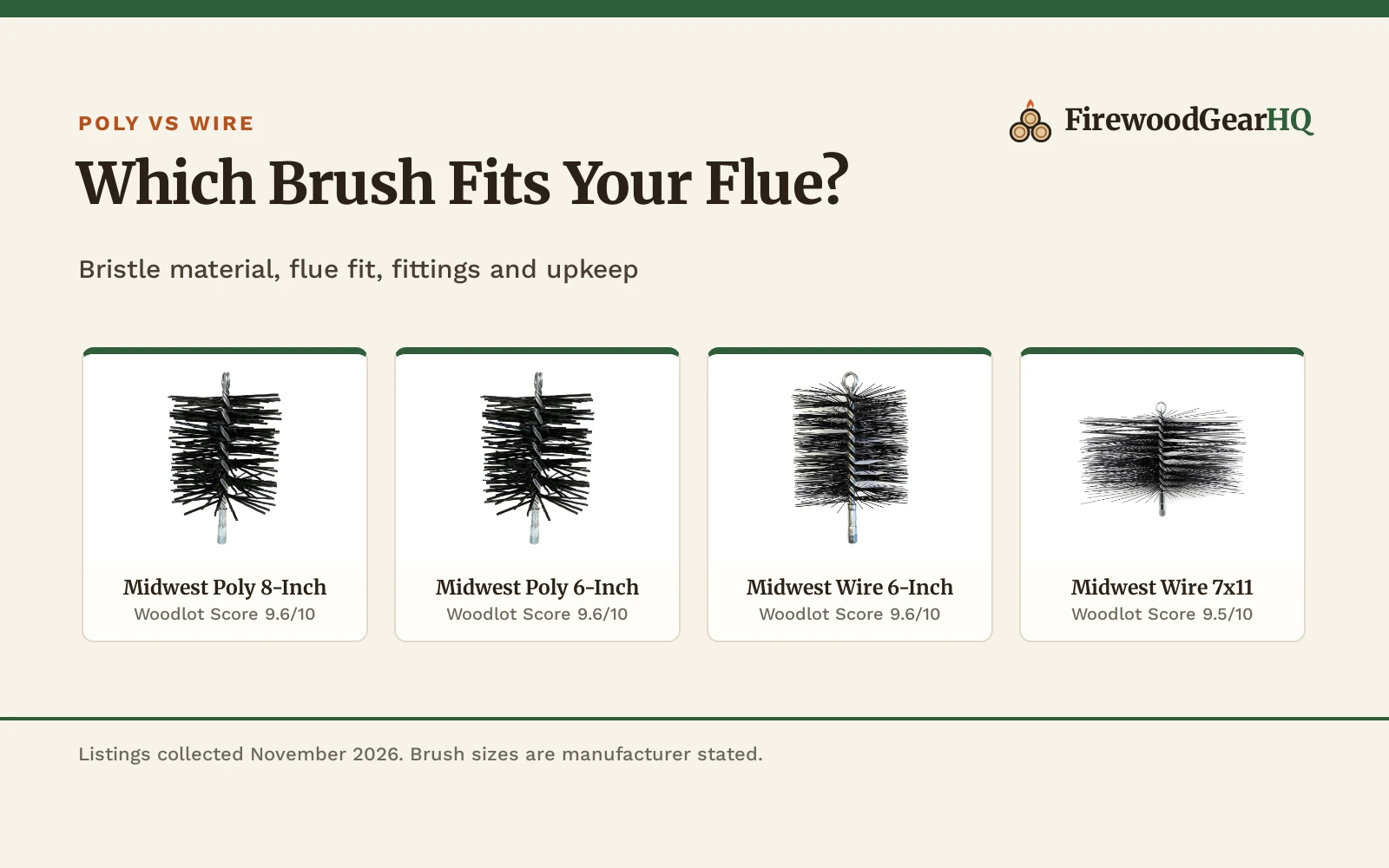
An 8-inch round poly chimney brush with stiff polypropylene bristles, a galvanized double-spiral steel stem and a 1/4 NPSM fitting, made in the USA for manual sweeping only.
Pros
- Stiff polypropylene bristles for metal flues
- Galvanized double-spiral steel stem
- 1/4 NPSM fitting for fiberglass rod kits
- 8-inch round fit for 8-inch round flue openings
Cons
- Rod kit sold separately
- Manual sweeping only, not for power drills or rotary tools
- Must match the flue size exactly
- No warranty term is stated
Midwest Hearth Poly Chimney Cleaning Brush
A 6-inch round poly chimney brush with stiff polypropylene bristles, a galvanized double-spiral steel stem and a 1/4 NPSM fitting, made in the USA for manual sweeping only. It weighs 10.56 ounces.
Pros
- Stiff polypropylene bristles for metal flues
- Galvanized double-spiral steel stem
- 1/4 NPSM fitting for fiberglass rod kits
- Available in 6-inch, 7-inch and 8-inch round sizes
Cons
- Rod kit sold separately
- Manual sweeping only, not for power drills or rotary tools
- Must match the flue size exactly
- No warranty term is stated

Midwest Hearth Wire Chimney Cleaning Brush
A 6-inch round wire chimney brush with tempered steel bristles, a galvanized double-spiral steel stem and a 1/4 NPSM fitting, made in the USA for manual sweeping only.
Pros
- Tempered steel bristles for masonry flues
- Galvanized double-spiral steel stem
- 1/4 NPSM fitting for fiberglass rod kits
- Made in the USA
Cons
- Rod kit sold separately
- Manual sweeping only
- Metal-flue use is not stated in the listing
- 6-inch round fit only; measure before ordering
Midwest Hearth Wire Chimney Cleaning Brush
A 7x11 rectangle wire chimney brush with tempered steel bristles, a galvanized double-spiral steel stem and a 1/4 NPSM fitting, made in the USA for manual sweeping only.
Pros
- Tempered steel bristles for masonry flues
- Straight wire bristle type
- Galvanized double-spiral steel stem
- 1/4 NPSM fitting for fiberglass rod kits
Cons
- Rod kit sold separately
- Manual sweeping only
- Metal-flue use is not stated in the listing
- 7x11 rectangle fit only; measure before ordering
More options to weigh up
 Rutland Products 16906 6-Inch Poly Chimney Cleaning BrushCheck price on Amazon
 Stanbroil 6 Inch Round Chimney Cleaning Brush with 1/4" NPTCheck price on Amazon
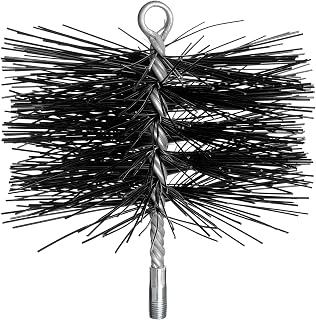 Stanbroil 8 Inch Round Chimney Cleaning Brush with 1/4" NPTCheck price on Amazon
 Midwest Hearth 4in Pellet Stove Chimney BrushCheck price on Amazon
 Teenyyou Chimney Cleaning Brush with 1/4 Npt Fitting 12 RodsCheck price on Amazon
 Meeco Mfg. CoCheck price on Amazon
Poly vs Wire Chimney Brush Side by Side
| Factor | Poly | Wire | Notes |
|---|---|---|---|
| Bristle material | Stiff polypropylene | Tempered steel | Poly holds its shape; wire suits masonry |
| Best for | Metal stove pipes and flexible liners | Masonry flues | Match the brush to the flue material |
| Sizes available | 6-inch, 7-inch and 8-inch round | 6-inch round and 7×11 rectangle | Match the size to the flue |
| Fitting | 1/4 NPSM | 1/4 NPSM | Both sides fit fiberglass rod kits |
| Sweeping method | Manual sweeping only | Manual sweeping only | Rod kits sold separately |
| Example weight | 10.56 ounces and 16 ounces | Not stated | Stated for the poly examples only |
| Example size | 6 x 6 x 9.5 in and 8 x 8 x 10.5 in | 6 x 6 x 9.5 in and 7×11 rectangle | Measure the flue before ordering |
Ranges are typical of the listings we reviewed; example figures are manufacturer stated, collected 21 October 2026.
Bristle Material: Poly vs Wire
Poly bristles are stiff polypropylene, and the maker says they hold their shape through repeated use, unlike wire bristles that can shed and damage flue walls. They scrub coal, soot and creosote from metal stove pipes, flue liners and chimneys. Wire bristles are tempered steel, listed for coal and soot on masonry flues and chimneys. Neither is better in general: the right one follows the flue it is made for.
Flue Fit: Round and Rectangle Sizes
Measure the inner flue diameter before ordering, and select a brush that matches the flue size exactly. The poly examples come in 6-inch, 7-inch and 8-inch round sizes; the poly examples here are the 6-inch and 8-inch round brushes. The wire examples are a 6-inch round brush and a 7×11 rectangle brush.
Where Each Brush Works
The poly examples list metal stove pipes and flexible liners as their best fit, and the maker says they are designed for masonry and metal stove pipe flues. The wire examples list masonry flues and chimneys, with metal flues left unstated.
Fittings and Rods
All 4 examples use a 1/4 NPSM fitting and fit fiberglass rod kits, sold separately. The poly examples list compatibility with Midwest Hearth’s 18-foot fiberglass rod extension kit. One fitting across the whole comparison means the rods are not the deciding factor; the flue material is.
Bristles, Stems and Upkeep
All 4 examples share a galvanized double-spiral steel stem, and the poly maker says the stem resists rust and corrosion. Poly bristles keep their shape through repeated use, and wire bristles are tempered steel for long-lasting durability. Chimneys should be cleaned annually, more often with heavy fireplace use.
Scoring the woodpile
Each example is scored out of 10 on performance, build, value, safety and warranty, using only what the listing publishes. The weights are on our How We Pick page.
| Product | Woodlot Score | Perf. /35 | Build /25 | Value /25 | Safety /10 | Warranty /5 |
|---|---|---|---|---|---|---|
| Midwest Poly 8-Inch | 9.5 | 30 | 21 | 21 | n/a | 0 |
| Midwest Poly 6-Inch | 9.4 | 29 | 21 | 21 | n/a | 0 |
| Midwest Wire 6-Inch | 9.3 | 28 | 21 | 20 | n/a | 0 |
| Midwest Wire 7×11 | 9.2 | 27 | 20 | 20 | n/a | 0 |
A tool’s weighted point total is placed between the 8.8 bottom and the 9.8 top of our scale; within a guide each rank shows at least 0.1 less than the one above it. Safety is scored for powered tools and for listings that name safety features; for hand tools without either, the score comes from 90 points.
Wear eye protection and gloves for cutting, splitting and handling, follow every tool's manual, install stoves to code, and have the chimney inspected and cleaned every year. See EPA Burn Wise and NFPA heating safety. Read our Safety Disclaimer.
Around the Woodpile
- Measure the inner flue diameter before ordering, and pick the brush size that matches the flue.
- Use the brush for manual sweeping only, with fiberglass rods; the rod kit is sold separately.
- Clean the chimney annually, more often with heavy fireplace use.
- Match the bristle to the flue: poly for metal stove pipes and flexible liners, wire for masonry flues.
FAQ: wood, fire and gear
Is a poly or wire chimney brush better for a metal flue?
Poly, on the examples here. The poly examples are made for metal stove pipes and flexible liners, while the wire examples are made for masonry flues and leave metal flues unstated.
Can I use a poly chimney brush on a masonry flue?
The poly maker says the brush is designed for masonry and metal stove pipe flues, with metal as its best fit. For a masonry flue, the wire examples are the ones made for it.
Can I use a wire chimney brush on a metal flue?
Not on the examples here. The wire examples state masonry flues, and leave metal flues unstated, so a metal flue calls for poly.
What size chimney brush do I need?
Match the brush to the inner flue diameter. The poly examples come in 6-inch, 7-inch and 8-inch round sizes, and the wire examples come in 6-inch round and 7×11 rectangle.
Do these brushes fit standard chimney rods?
All 4 examples use a 1/4 NPSM fitting for fiberglass rod kits, and the kits are sold separately.
More firewood guides
See the chimney brush vs chimney sweep kit comparison, the chimney brush vs cleaning rods comparison, the stove pipe vs chimney pipe comparison and the chimney cap size comparison.