Jig vs Freehand Chainsaw Sharpening: Which One Should You Buy?
Jig vs freehand chainsaw sharpening: how they differ in angle control, speed and skill, with four sharpening jigs from the listings ranked by features, chain fit and what ships in the box.

On this page
Top picks at a glance
As an Amazon Associate I earn from qualifying purchases.
- 1
 PFERD CS-X Chainsaw Chain Sharpener9.7/10View on Amazon
- 2
 Granberg G106B Chainsaw Sharpener9.5/10View on Amazon
- 3
 Dremel 1453 Chainsaw Sharpening Kit9.4/10View on Amazon
- 4
 Oregon 104004 Chainsaw Sharpening KitsView on Amazon
- 5
 Oregon 543429 Chainsaw Sharpening KitsView on Amazon
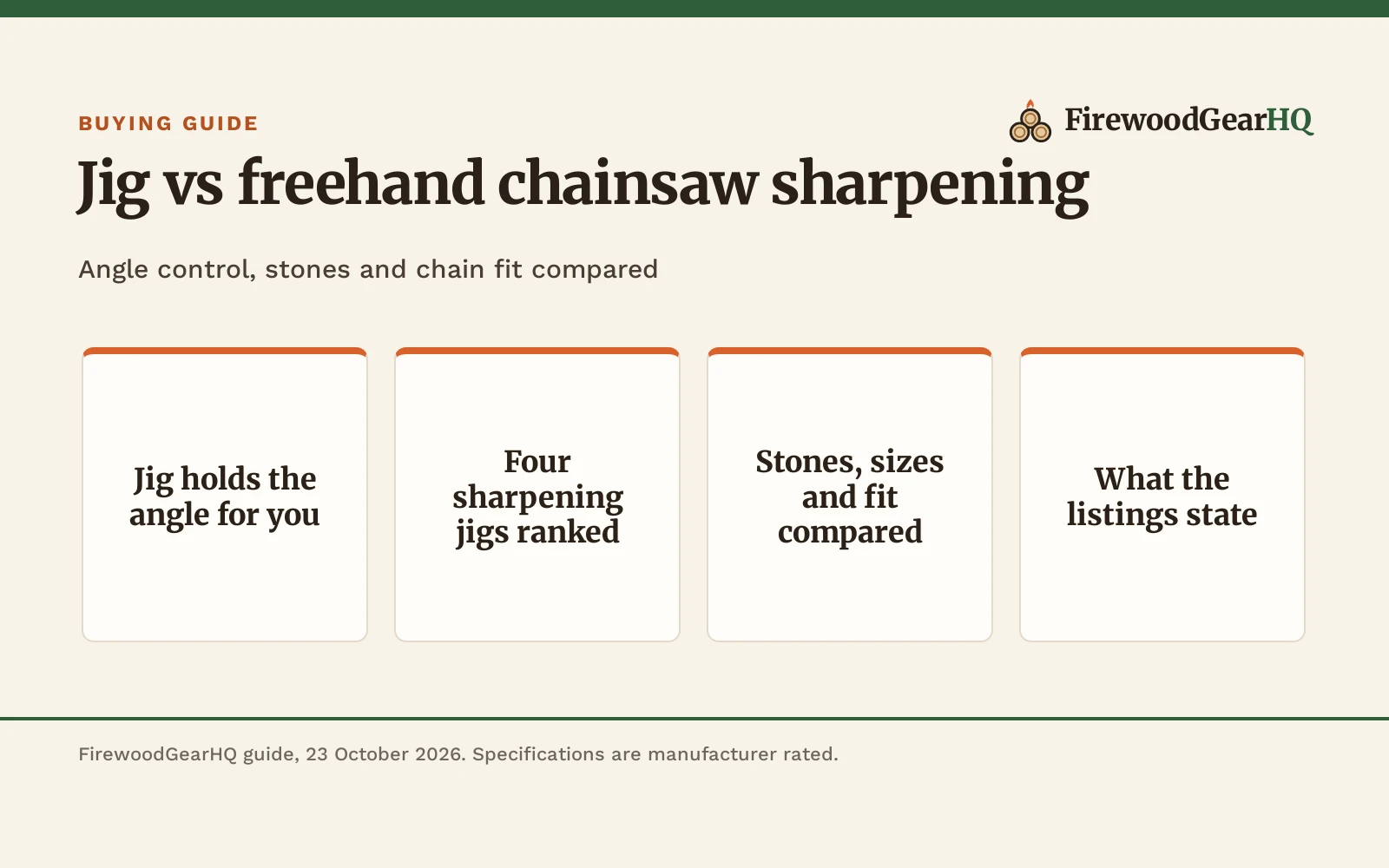
A dull chain turns cutting into pushing, and the fix is either a jig that holds the angle for you or a free hand and a file: jig vs freehand chainsaw sharpening, which one should you buy? A jig locks in the filing angle and depth so every tooth comes out the same; freehand filing is faster once you learn it but lives or dies on your eye. This guide explains how the two methods differ, then ranks the four sharpening jigs the listings sell by features, chain fit and what ships in the box.
More options to weigh up
 Oregon 104004 Chainsaw Sharpening KitsCheck price on Amazon
 Oregon 543429 Chainsaw Sharpening KitsCheck price on Amazon
FirewoodGearHQ earns a small commission if you buy through links on this page. The price you pay stays the same. Read our affiliate disclosure.
Jig vs freehand chainsaw sharpening: the quick answer
A jig suits anyone who wants consistent angles without practice: the listings here describe guides that lock in filing angles and depth settings, with fixed sharpening holes and a standard 30 degree front angle. Freehand filing suits experienced hands who can hold an angle by eye and want the fastest touch-up in the woods. If your teeth come out uneven, the jig wins; if you file by feel and your chains cut straight, freehand wins.
How jig sharpening differs from freehand filing
The difference is angle control. A jig holds the file or stone at a fixed angle: the Oregon guide locks in filing angles and depth settings, the BOSRUIDA and NINGHW jigs use two fixed sharpening holes with a 30 degree front angle, and the Dremel kit includes an angle guide attachment for its rotary tool. Freehand filing holds nothing: you set the angle by eye and keep it steady through every tooth. The jig trades a little setup time for repeatability; freehand trades repeatability for speed.
What ships in the box differs too. The jigs here come with stones and accessories: the Dremel kit includes 4 grinding stones in 4.0, 4.5 and 4.8 mm sizes, the BOSRUIDA ships 5 sharpening stones with a wrench and a protective glove, and the NINGHW kit ships 10 grinding stones with gloves and a cleaning brush. Freehand filing needs only a file and the knowledge to use it. If you are buying your first sharpening setup, a jig kit gives you everything in one box.
The gear: four sharpening jigs, ranked
Four sharpening jigs from the listings, ranked by features, chain fit and what ships in the box.
BOSRUIDA hand-held sharpening jig
The most complete jig here. It fits 8 inch to 22 inch chainsaw blades, with chain sizes from .325″-3/16″ and .404″-7/32″ to 3/8″P-3/16″, 3/8″P-5/32″ and 3/8″-13/64″. The manual crank design moves the burr to a fixed position on the crank arm, two fixed sharpening holes and a 30 degree front angle prevent wrong angles, and the body is stainless steel and aluminum alloy. It ships with 5 sharpening stones, a wrench, a handle accessory and a protective glove, and weighs 1.17 pounds.
NINGHW hand crank sharpening jig kit
The biggest stone count: 10 grinding stones, with 8 high hardness 5.5mm bits and 2 high hardness 4mm bits. It fits 4 inch to 22 inch chain saws, with two fixed sharpening holes and a standard 30 degree front angle. The listing says it can restore a dull chain in 3 to 5 seconds of cranking, and the pawl positions each tooth consistently. Gloves, a cleaning brush, a wrench and instructions ship in the kit, and the body is a rust-resistant alloy.
Dremel 1453 sharpening kit
The rotary tool option. It includes a sharpening angle guide attachment, an adjustment gauge and 4 grinding stones in 4.0 mm, 4.5 mm and 4.8 mm sizes, with grinding depth up to 30 mm. It is made to sharpen multiple different sized chains and extend chain life. Note it is an accessory set for a rotary tool: the tool itself is not in the box. It weighs 0.81 ounces and measures 5.91 x 3.54 x 1.57 inches.
Oregon 23820 Sure Sharp filing guide
The simplest pick: a manual filing guide that locks in filing angles and depth settings for consistently correct filing, with built-in instructions and a filing chart on the package. It lists a universal fit for all pitch saw chains. It ships as the guide only, with no stones or files in the box, and measures 5.55″L x 10.2″W x 2.55″H. The spec table lists 0.27 g for weight, which does not match a filing guide, so treat that figure as a listing error.
Angles, stones and chain sizes
Angles are the heart of the jig question. The BOSRUIDA and NINGHW both use a 30 degree front angle with two fixed sharpening holes; the Oregon locks in filing angles and depth settings without naming degrees; the Dremel uses an angle guide attachment with an adjustment gauge. Stones come in the box with three of the four: 4 stones in 3 sizes with the Dremel, 5 stones with the BOSRUIDA, and 10 stones with the NINGHW. Chain fit is stated most specifically on the BOSRUIDA, which names .325, .404 and 3/8 inch pitch sizes; the Oregon instead claims a universal fit for all pitch saw chains. The NINGHW fits 4 inch to 22 inch bars against the BOSRUIDA’s 8 inch to 22 inch range.
What to check before you buy
Check what the jig needs that is not in the box. The Dremel kit is a rotary tool accessory set, so you need the rotary tool. The Oregon is a guide only, so you need files. The BOSRUIDA and NINGHW are hand-crank jigs that work standalone. Check bar fit: the BOSRUIDA starts at 8 inch bars while the NINGHW starts at 4 inch. On warranty, the Oregon spec table names a warranty with no term, and the others state none. The BOSRUIDA and NINGHW ship gloves; only the NINGHW ships a cleaning brush.
FAQ: wood, fire and gear
Is a jig better than freehand sharpening?
A jig holds the filing angle for you, so every tooth comes out the same; the guides here lock in a 30 degree front angle with fixed holes or an angle attachment. Freehand filing is faster once learned but depends on your eye. Beginners get more consistent results with a jig.
What chain sizes do these jigs fit?
The BOSRUIDA names .325, .404 and 3/8 inch pitch chain sizes and fits 8 inch to 22 inch bars. The NINGHW fits 4 inch to 22 inch chain saws. The Oregon lists a universal fit for all pitch saw chains. The Dremel fits multiple different sized chains with its 4 stones in 4.0, 4.5 and 4.8 mm.
Do these kits include sharpening stones?
The Dremel includes 4 grinding stones, the BOSRUIDA includes 5 sharpening stones, and the NINGHW includes 10 grinding stones. The Oregon is a filing guide only, with no stones or files in the box.
Which jig needs no extra tools?
The BOSRUIDA and NINGHW are hand-crank jigs that work standalone. The Dremel kit needs a rotary tool, and the Oregon guide needs files.
Which of these has a stated warranty?
The Oregon spec table names a warranty with no term stated. The other three listings state no warranty.
More firewood guides
See our hand crank vs electric chainsaw sharpener and electric chainsaw sharpener vs file comparisons. For files, see the best chainsaw file for homeowners picks, and compare chainsaw file vs bench grinder.