Infrared Heater vs Radiant Heater: Which One Should You Buy?
Infrared and radiant heat overlap, so this comparison puts a 10,000-watt DR salamander against a 1,500-watt hykolity quartz tower on power, controls, safety and power supply.

On this page
Top picks at a glance
As an Amazon Associate I earn from qualifying purchases.
- 1
 DR. INFRARED HEATER DR-PS11024 Salamander9.6/10View on Amazon
- 2
 Hykolity 1,500 Watt Radiant Quartz Tower Space9.5/10View on Amazon
Verdict: Choose the DR infrared example if you have a 240-volt circuit and hardwiring in place and need the stronger heat. Choose the hykolity radiant example if you want a portable room heater with 3 heat settings for a home office.
Both examples heat electrically and both carry a fan, but they are built for different jobs. One is a salamander on a cart, and the other is a tower for a room. This infrared heater vs radiant heater comparison covers what separates them, then one example of each from the listings we reviewed.
FirewoodGearHQ earns a small commission if you buy through links on this page. The price you pay stays the same. Affiliate disclosure.
Two examples
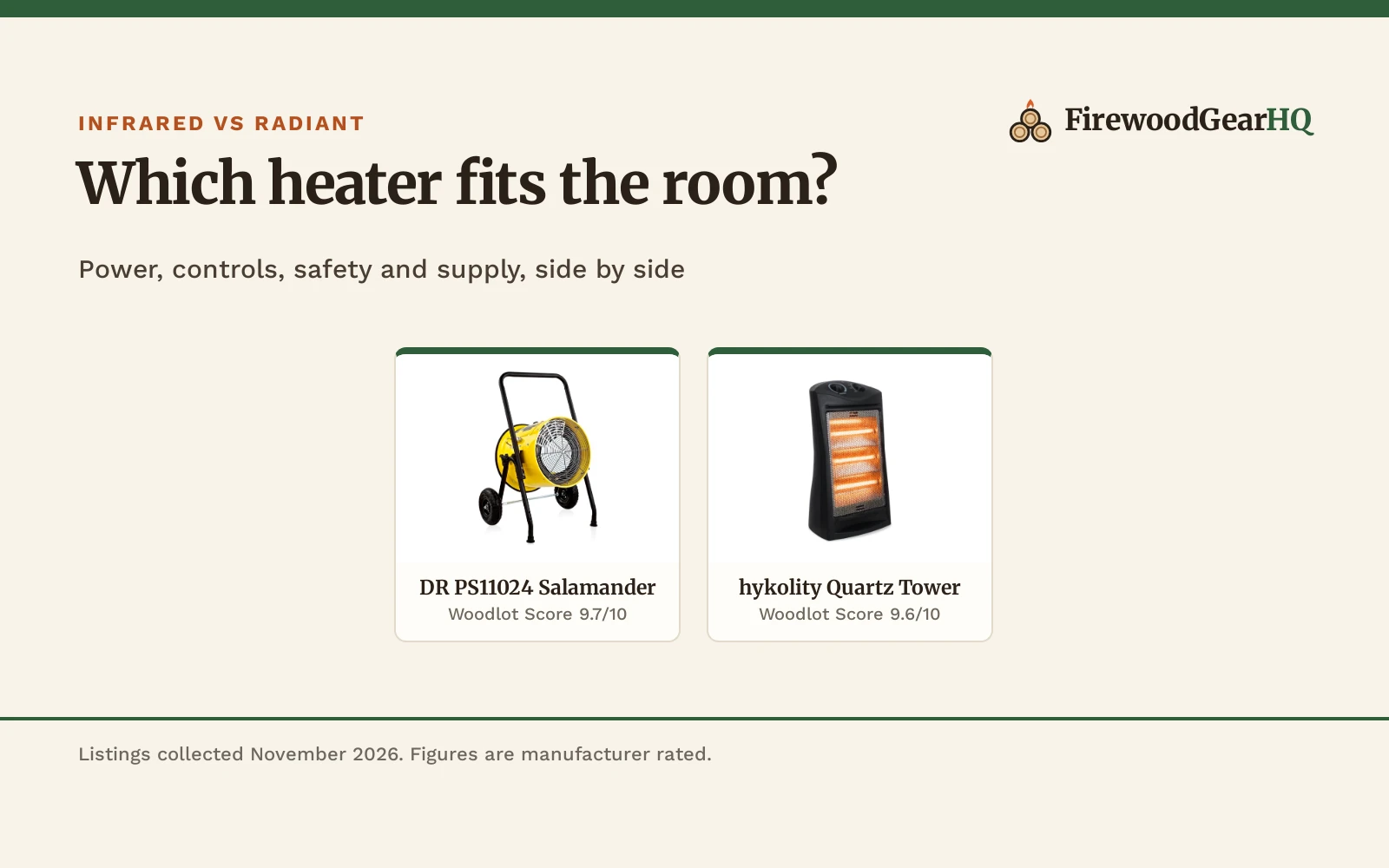
DR. INFRARED HEATER DR-PS11024 Salamander
A 10,000-watt, 240-volt fan-forced electric heater with a 37 to 104 degree thermostat, a heavy-duty steel frame, safety guards on both ends and a cart, with hardwiring required.
Pros
- 10,000-watt fan-forced heat, rated at 240 volts
- Adjustable thermostat from 37 to 104 degrees Fahrenheit
- Heavy-duty steel frame with safety guards on both ends
- Cart included for moving the heater
Cons
- Needs a 240-volt circuit and a 55-amp breaker
- Hardwiring required
- 69.0 lb listed weight
- No tip-over shutoff is stated
Hykolity 1,500 Watt Radiant Quartz Tower Space
A 1,500-watt radiant quartz tower heater with 3 heat settings, 3 quartz tubes, an adjustable thermostat, a built-in fan, tip-over shutoff and overheat protection.
Pros
- 3 heat settings: 1500, 1000 and 500 watts
- 3 quartz tubes with a built-in fan for even heat coverage
- Tip-over shutoff and overheat protection stated
- Flame-retardant plastic shell, and the maker states the heater runs at 45 dB
Cons
- No warranty term is stated
- Plastic outer shell, not steel
- Thermostat is Min-Max only, with no stated temperature range
- No coverage area is stated
More options to weigh up
 DR. INFRARED HEATER DR-978 New Upgraded Dual Heating HybridCheck price on Amazon
 EXNOS 1500W Infrared Heater for Indoor UseCheck price on Amazon
 Outdoor Electric Infrared Patio HeaterCheck price on Amazon
 Garvee 3000W Infrared Electric Patio HeaterCheck price on Amazon
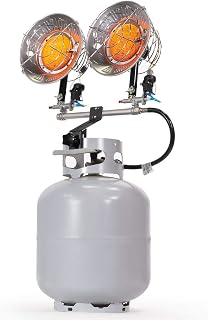 XtremepowerUS Propane Tank Top HeaterCheck price on Amazon
 Mr. Heater MH9BX Portable Buddy HeaterCheck price on Amazon
Side by side
| Factor | Infrared heater | Radiant heater | Notes |
|---|---|---|---|
| Rated power | 10,000 watts (DR example) | 1,500 watts high (hykolity example) | The DR example is rated far higher |
| Controls | Thermostat 37 to 104 °F (DR example) | 3 settings: 1500, 1000, 500 watts | The hykolity example lists 3 heat levels |
| Fan | Fan forced (DR example) | Built-in fan (hykolity example) | Both examples state a fan |
| Safety features | Guards on intake and output ends | Tip-over shutoff, overheat protection | Each example states different features |
| Weight | 69.0 lb, with cart (DR example) | 7.03 lb (hykolity example) | The DR example is the heavier unit |
| Power supply | 240 volts, 55-amp breaker, hardwiring | Not stated | The DR example needs a 240-volt circuit |
| Warranty | 1 year (DR example) | Not stated | Only the DR example states a term |
Those numbers are what each brand claims on its listing, collected 14 November 2026, not shop measurements.
Infrared heater vs radiant heater: what separates them
Radiant heat and infrared heat name the same kind of warmth: heat that travels as radiation from a hot element. The hykolity example shows the overlap, since it is tagged radiant yet its own description calls the heat infrared and uses 3 quartz tubes. What separates the two examples here is not the physics but the build: a 10,000-watt salamander on a cart against a 1,500-watt tower for a room.
Power: watts and what they heat
The DR example is rated 10,000 watts at 240 volts, and the hykolity example is rated 1,500 watts at high, with 1000 watts at medium and 500 watts at low. Both listings state their watts, so the gap is a stated one: the DR example is rated far higher. The hykolity example suits a room, as its own description says, while the DR example is a salamander built for construction use.
Controls: thermostat and heat settings
The DR example states an adjustable thermostat with a range from 37 to 104 degrees Fahrenheit. The hykolity example states an adjustable Min-Max thermostat with no temperature range given, and 3 heat settings to choose from. Both examples state a fan: the DR example is fan forced, and the hykolity example has a built-in fan that spreads hot air through the room.
Safety features and power supply
The DR example states safety guards on both the intake and output ends and a heavy-duty steel frame. The hykolity example states automatic tip-over shutoff, overheat protection and a flame-retardant shell. The two examples state different safety features, so neither side wins on safety from these listings alone. On power, the DR example needs a 240-volt circuit, a 55-amp breaker and hardwiring, while the hykolity example states no voltage or circuit figure.
Scoring the woodpile
Each example is scored out of 10 on performance, build, value, safety and warranty, using only what the listing publishes. How we pick explains the weights.
| Product | Woodlot Score | Perf. /35 | Build /25 | Value /25 | Safety /10 | Warranty /5 |
|---|---|---|---|---|---|---|
| DR PS11024 Salamander | 9.6 | 30 | 21 | 20 | 8 | 2 |
| hykolity Quartz Tower | 9.5 | 28 | 20 | 21 | 9 | 0 |
A tool’s weighted point total is placed between the 8.8 bottom and the 9.8 top of our scale; within a guide each rank shows at least 0.1 less than the one above it.
Wear eye protection and gloves for cutting, splitting and handling, follow every tool's manual, install stoves to code, and have the chimney inspected and cleaned every year. See EPA Burn Wise and NFPA heating safety. Read our Safety Disclaimer.
Around the Woodpile
- Move the DR example on its cart; at 69.0 lb it is the heavier example here.
- The hykolity example weighs 7.03 lb and moves room to room.
- Use the DR example only where a 240-volt circuit and hardwiring are in place.
- Keep both examples clear of anything that burns, and follow the maker manual for placement.
FAQ: wood, fire and gear
How does an infrared heater work?
An infrared heater warms with radiant heat from a hot element. The hykolity example uses 3 quartz tubes to make radiant heat, and the DR example is a fan-forced electric heater. Both examples state a fan, which moves the warm air.
Is an infrared heater safe?
The listings state different safety features, not a general answer. The DR example states guards on both ends, and the hykolity example states tip-over shutoff, overheat protection and a flame-retardant shell. Check the features the listing states and follow the maker manual.
Can infrared heaters cause fires?
The listings do not state fire risk. The hykolity example states tip-over shutoff, overheat protection and a flame-retardant shell, and the DR example states guards on both ends. Keep the heater clear of anything that burns and follow the maker manual.
What is an infrared heater?
An infrared heater warms with radiant heat from a hot element. The DR example is a 10,000-watt salamander, and the hykolity example is a 1,500-watt quartz tower. Both heat electrically and both state a fan.
What is the difference between an infrared heater and a radiant heater?
The names overlap: radiant heat travels as infrared radiation. The hykolity example is tagged radiant yet calls its own heat infrared and uses 3 quartz tubes. In these two examples the difference is the build, not the heat: a 10,000-watt salamander against a 1,500-watt tower.
More firewood guides
See the indoor heating guides, the best infrared heaters, the best indoor heaters, the ceramic vs infrared space heater comparison and the infrared heater vs oil filled radiator comparison.