Electric vs Gas Patio Heater: Which One Should You Buy?
Electric and gas patio heaters compared by power source, heat style, controls and weather resistance, with two electric infrared listings described.

On this page
Top picks at a glance
As an Amazon Associate I earn from qualifying purchases.
- 1
 ThermoMate Infrared Patio Heater 3000W 240V Hard Wired Carbon9.7/10View on Amazon
- 2
 FOOWIN Patio Heater 489.2/10View on Amazon
- 3
 Paraheeter Outdoor Electric Infrared Patio Heater9.6/10View on Amazon
- 4
 Electric Patio HeaterView on Amazon
- 5
 Outdoor Electric Infrared Patio HeaterView on Amazon
- 6
 Garvee 3000W Infrared Electric Patio HeaterView on Amazon
- 7
 Upgraded Patio Heater Reflector ShieldView on Amazon
- 8
 ThermoMate Electric Infrared Patio Heater 1500W Low GlareView on Amazon
- 9
 SereneLife Outdoor Electric Patio HeaterView on Amazon
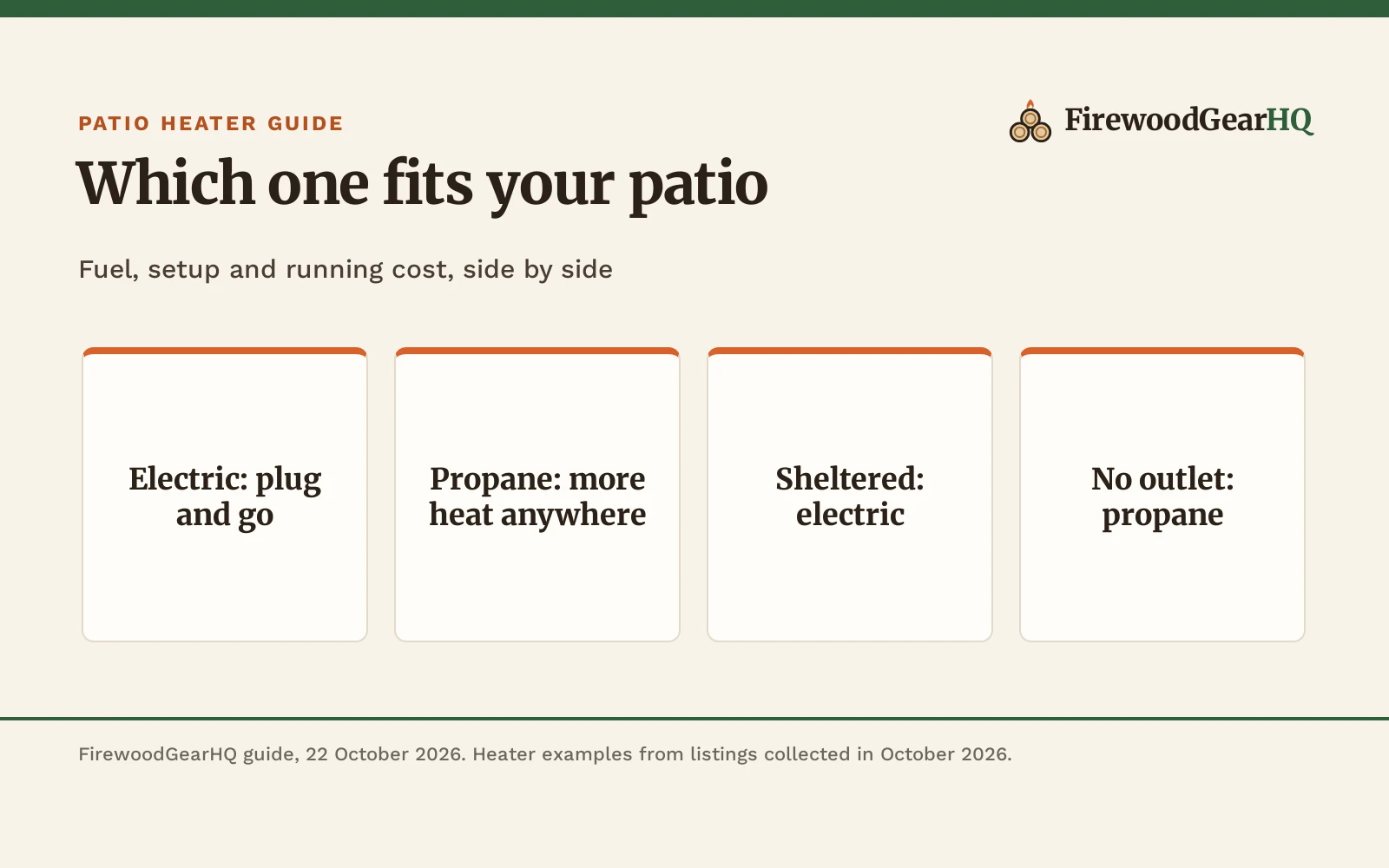
An evening on the patio turns on whether heat reaches the chairs or drifts away, and electric vs gas patio heater comes down to power source and heat style. An electric infrared heater warms people and objects directly and plugs into an outlet, while a gas heater burns fuel and needs no outlet. For a patio with an outlet close at hand, electric is the simpler setup; for a patio far from any outlet, gas is the workable option.
More options to weigh up
 Electric Patio HeaterCheck price on Amazon
 Outdoor Electric Infrared Patio HeaterCheck price on Amazon
 Garvee 3000W Infrared Electric Patio HeaterCheck price on Amazon
 Upgraded Patio Heater Reflector ShieldCheck price on Amazon
 ThermoMate Electric Infrared Patio Heater 1500W Low GlareCheck price on Amazon
 SereneLife Outdoor Electric Patio HeaterCheck price on Amazon
FirewoodGearHQ earns a small commission if you buy through links on this page. The price you pay stays the same. Read our affiliate disclosure.
Electric vs gas patio heater: the quick answer
Electric patio heaters suit patios with an outlet nearby: plug in, pick a heat level, and the infrared element warms the people in front of it without an open flame. Gas patio heaters suit patios without an outlet, since they burn fuel instead of drawing power, but they need a fuel supply on hand and care around an open flame. The two listings described below are both electric infrared heaters, each with three heat levels, a remote and a timer, so the electric side of this comparison is grounded in stated specs while the gas side is described in general terms.
How the two sides compare
| Aspect | Electric | Gas |
|---|---|---|
| Power source | An outlet, per both listings below | Fuel, with no outlet needed |
| Heat style | Infrared radiant heat aimed at people and objects | Flame heat from a gas burner |
| Controls | Remote control and a timer, per both listings below | Hand-adjusted flame control, in general terms |
| Weather resistance | IP65 on one listing, IP44 on the other | Open flame needs shelter from strong wind |
| Upkeep | No fuel to buy, store or refill | Fuel supply to monitor and replace |
Use the table to narrow the choice, then check the listing for the model in hand before buying, since figures vary by model.
The electric listings in this guide
The Garvee infrared patio heater is a freestanding electric model on a sturdy iron tripod, with a durable aluminum housing and an adjustable height. The listing states three heat levels at 500W, 1000W and 1500W, a remote control in aluminum, a 24-hour timer, and an IP65 rating, with an item weight of 14.8 pounds. Carbon fiber infrared heating is the stated heat source, and the listing names patios, decks, balconies, gardens, garages and outdoor gatherings as uses. The tripod form means it can be moved to where warmth is needed, and the timer can switch the heater on or off automatically.
The MEPTY outdoor electric heater is a tower-form infrared model with remote and touch control, also stating three heat levels at 500W, 1000W and 1500W and a 24-hour timer. The listing states carbon fiber heating wire with an aluminum reflector, quiet operation without fans, tip-over and overheat protection, V0-grade flame-retardant materials and an IP44 rating. Warmth within 2 seconds is the listing claim for how fast heat arrives, and the remote adjusts settings from a distance. Compared with the Garvee listing, the MEPTY listing states safety shutoffs and a lower water rating, while the Garvee listing states a tripod stand, an aluminum housing and a higher water rating.
Choosing for your patio
Check the outlet first
The outlet question decides the fuel question. Both listings here draw power from an outlet, so a patio without one nearby points toward gas, while a patio with an outlet points toward electric. Neither listing states a cord length, so check the listing for the model in hand and plan the placement around the outlet rather than assuming the heater reaches any corner of the patio.
Match heat levels to seating
Both listings state the same three heat levels, 500W, 1000W and 1500W, with a remote and a 24-hour timer, so the choice between them turns on form and ratings rather than power steps. A tripod model like the Garvee listing suits an open patio where the heater stands on the floor among chairs, while a tower model like the MEPTY listing suits a spot on the patio floor. Set the timer for the evening rather than leaving the heater running, since both listings include that control.
Think about wind and rain
Water ratings separate the two listings: the Garvee listing states IP65, while the MEPTY listing states IP44, so the Garvee listing claims the stronger water resistance of the pair. Infrared heat warms people and objects directly, which helps in a breeze compared with heating air alone, and the MEPTY listing notes its warmth remains effective even in breezy conditions. For gas, wind matters more, since an open flame can struggle in a strong breeze and needs clearance from fabrics and furniture.
FAQ: wood, fire and gear
Do electric patio heaters need an outlet?
Yes, for the listings described here. Both listings state an electric power source, so an outlet must be within reach of the heater placement. A patio without an outlet nearby is the main reason to consider gas instead.
Which electric listing has the higher water rating?
The Garvee listing states IP65, while the MEPTY listing states IP44. Both listings describe water resistance for outdoor use, but the Garvee rating is the higher of the two stated figures.
Do both listings include a remote and a timer?
Yes. The Garvee listing includes an aluminum remote control and a 24-hour timer, and the MEPTY listing includes remote and touch control with a 24-hour timer. Both also state three heat levels at 500W, 1000W and 1500W.
Can these heaters run indoors as well as outdoors?
The Garvee listing describes outdoor patio use only, naming patios, decks, balconies, gardens, garages and outdoor gatherings. The MEPTY listing describes a versatile indoor-outdoor heater, naming patios, garages, balconies and cafes among its spaces. Check the listing for the model in hand before placing any heater in an enclosed room.
What safety features do the listings state?
The MEPTY listing states tip-over and overheat protection, V0-grade flame-retardant materials and an IP44 rating. The Garvee listing states an IP65 rating and a sturdy iron tripod stand, but states no tip-over or overheat shutoff. Compare the stated features model by model rather than assuming every electric heater carries the same protections.
More firewood guides
See the wood stoves hub, the stove accessories hub and the best outdoor heater for a gazebo.