Class A vs Class B Chimney Pipe: Which One Should You Buy?
Class A and Class B chimney pipe labels are not interchangeable, and this guide explains the Class A listings, their construction, and how to match a pipe to an appliance maker requirement.

On this page
Top picks at a glance
As an Amazon Associate I earn from qualifying purchases.
- 1
 Duravent DuraPlus9.6/10View on Amazon
- 2
 AllFuel HST Chimney Pipe9.5/10View on Amazon
- 3
 AllFuel HST 6" x 48" 304 Stainless Steel All Fuel Class-A9.5/10View on Amazon
- 4
 Fireproof Pipe WrapView on Amazon
- 5
 Selkirk 208024 8" X 24" Insulated Chimney PipeView on Amazon
- 6
 6" X 39" Chimney Pipe Class-AView on Amazon
- 7
 Stove Pipe Adaptor for 6" Diameter 304 Stainless Steel AllView on Amazon
- 8
 8" X 48" Chimney Pipe Class-AView on Amazon
Fall prep usually ends with a look at the flue, and a label question can stop that work cold: class a vs class b chimney pipe, and which label fits the appliance at the hearth. The short answer is that the labels are not interchangeable names for the same pipe. Class A pipe is a distinct class with its own listing, and Class B pipe is a separate class with its own listing. This guide explains the Class A listings in the gear section below, what their construction states, and how to match a pipe label to the requirement the appliance maker gives for the appliance in your home.
More options to weigh up
 Fireproof Pipe WrapCheck price on Amazon
 Selkirk 208024 8" X 24" Insulated Chimney PipeCheck price on Amazon
 AllFuel HST Chimney PipeCheck price on Amazon
 6" X 39" Chimney Pipe Class-ACheck price on Amazon
 Stove Pipe Adaptor for 6" Diameter 304 Stainless Steel AllCheck price on Amazon
 8" X 48" Chimney Pipe Class-ACheck price on Amazon
FirewoodGearHQ earns a small commission if you buy through links on this page. The price you pay stays the same. Read our affiliate disclosure.
Class A vs Class B Chimney Pipe: The Short Answer
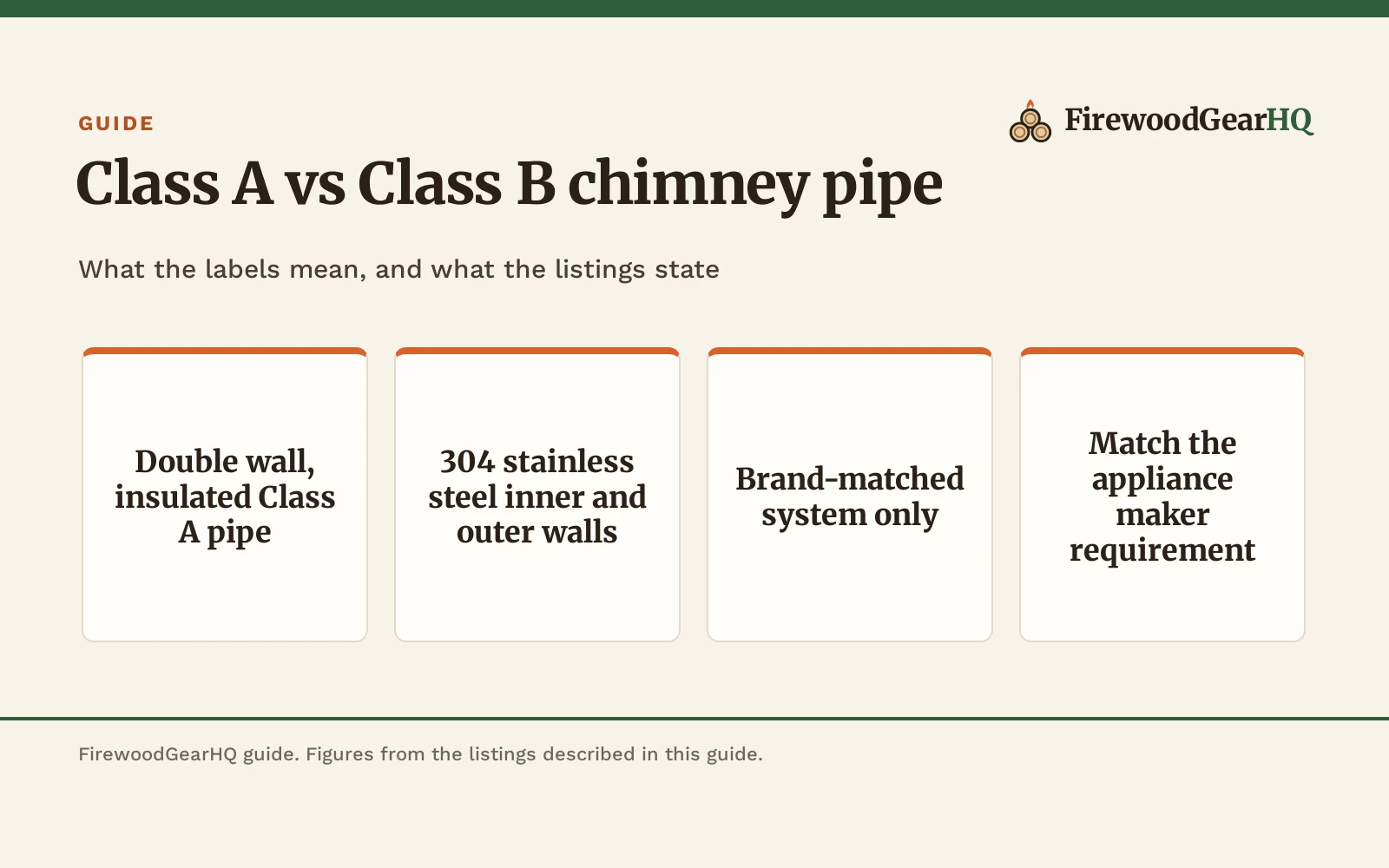
For a wood stove, fireplace, firebox, furnace, boiler, water heater, or outdoor wood furnace fueled by wood, gas, coal, or oil, the listings in this guide describe Class A pipe, subject to the diameter and system checks in the choosing section below, because that is the class the AllFuel HST listings describe. The listings state that the pipe is certified to UL103HT, and they describe it as all fuel Class-A double wall insulated chimney pipe.
Class B pipe is not a shorter or longer form of the pipe described here, and it is not covered by the listings in the gear section below. If the appliance maker calls for Class B pipe, these Class A listings do not answer that call, and if the appliance maker calls for Class A pipe, a Class B label does not answer it either. Match the label the appliance maker gives, match the brand system the listing gives, and ask a certified pro about local code before any flue work. This guide gives no chimney installation steps, and it does not replace the appliance maker manual or local code.
What Class A Pipe Is, From the Listings
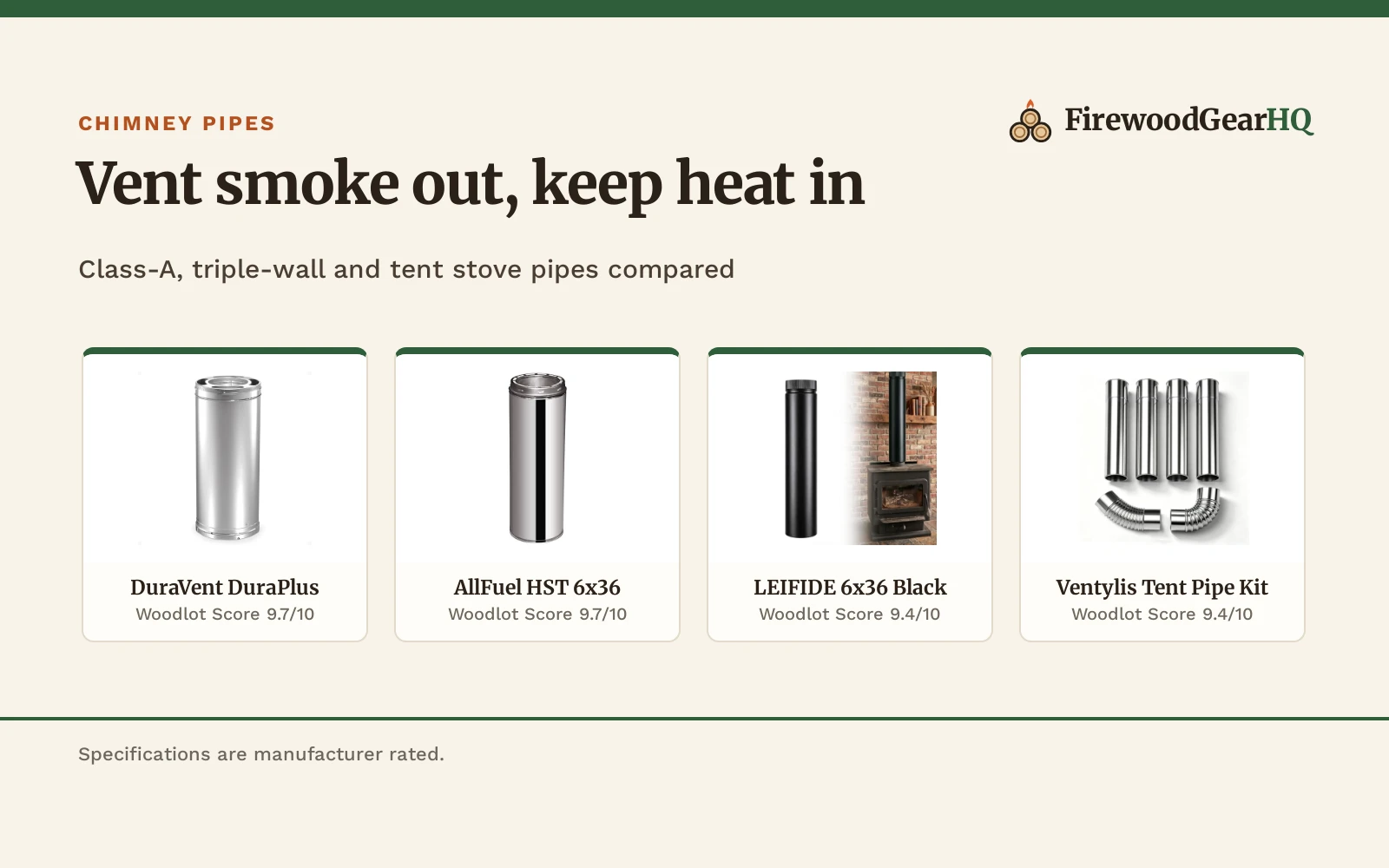
The AllFuel HST listings describe double wall insulated chimney pipe with 304 stainless steel inner and outer walls and laser welded seams. The listing states that the walls provide corrosion resistance over galvanized steel or 430 stainless steel construction, stated as the maker claim in neutral terms. Inside the walls, a ceramic fiber blanket provides insulation, and the listing states that the insulation helps maintain high internal flue temperatures for a proper draft while giving a 2″ clearance to combustibles. Twist-Lock connections join the sections, and the included locking band keeps the chimney sealed tightly.
Compatibility is narrow, and that matters as much as the construction. The listings state that the pipe is compatible with AllFuel HST Class-A double wall chimney pipe, and that it can not be connected to other brands of class-A chimney. A buyer with a different brand system does not gain compatibility from the same diameter and the same Class A label, because the listing limits connection to the AllFuel HST system.
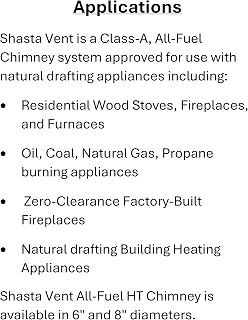
The appliance range in the listing is broad, and it is worth reading in full. The listing states that the pipe is perfect for wood stoves, fireplaces, fireboxes, furnaces, boilers, water heaters, outdoor wood furnaces, or other residential heating appliances fueled by wood, gas, coal, or oil. The appliance maker manual still governs the appliance in the home. See also the comparison of double wall vs triple wall chimney pipe for how wall construction labels differ, and the clay vs stainless chimney liner guide for a different flue material question.
| Feature | Class A, from the listings | Class B, from the listings |
|---|---|---|
| Wall construction | Double wall, insulated, with a ceramic fiber blanket | Not stated |
| Wall material | 304 stainless steel inner and outer walls, laser welded seams | Not stated |
| Clearance to combustibles | 2″ clearance stated | Not stated |
| Certification stated | UL103HT | Not stated |
| Brand system | AllFuel HST Class-A system only | Not stated |
| Sections in this guide | 6″ x 24″ and 6″ x 12″ sections | Not stated |
The Gear in This Guide
Both sections below share the same construction, the same certification, and the same brand-system limit. They differ in length, and length is the choice between them. The longer section heads the ranking because a longer section covers more of a straight run with fewer joints in the run, while the shorter section gives a shorter option for a run layout.
AllFuel HST 6″ x 24″ Class-A Double Wall Insulated Chimney Pipe
This is the longer section in the guide, at 6″ x 24″, with 304 stainless steel inner and outer walls, laser welded seams, and a ceramic fiber blanket inside double wall construction. The listing states a 2″ clearance to combustibles, Twist-Lock connections, a locking band, and certification to UL103HT. It is compatible with AllFuel HST Class-A double wall chimney pipe only, and it can not be connected to other brands of class-A chimney. The appliance range matches the listing above, from wood stoves and fireplaces to furnaces, boilers, water heaters, and outdoor wood furnaces fueled by wood, gas, coal, or oil.
AllFuel HST 6″ x 12″ Class-A Double Wall Insulated Chimney Pipe
This is the shorter section in the guide, at 6″ x 12″, with the same 304 stainless steel inner and outer walls, laser welded seams, and ceramic fiber blanket insulation as the longer section. It carries the same 2″ clearance to combustibles, the same Twist-Lock connections and locking band, and the same UL103HT certification. It is also limited to the AllFuel HST Class-A system, and it can not be connected to other brands of class-A chimney. Where a run needs a short section to complete its length, this section keeps the run inside the same system, the same material, and the same label.
Which Label Should You Buy
Start with the appliance maker manual, not with the pipe aisle. If the manual calls for Class A pipe, the listings in this guide describe Class A pipe in the AllFuel HST system, and the remaining checks are diameter, system match, and local code. If the manual calls for Class B pipe, look for a Class B listing for that system instead, because the listings here do not describe Class B pipe. A label swap is not a small change, and it is not fixed by matching diameter alone.
Next, check the system already in place, if any system is in place. AllFuel HST sections connect to AllFuel HST Class-A pipe, and the listing states that they can not be connected to other brands of class-A chimney. A mixed-brand run fails the listing condition even when the labels match on paper. A certified pro can confirm the system, the label, and local code for the home, and that check belongs before purchase, not after.
Finally, keep the safety basics in view. Stove and flue work follows the maker manual and local code, with clearances as the listing and the manual state them, smoke and CO alarms in place, seasoned wood only for wood burning, and an annual chimney inspection. The 2″ clearance in these listings belongs to this pipe, not to other pipe or other systems.
FAQ: wood, fire and gear
Can I mix AllFuel HST Class-A pipe with another brand of Class-A pipe?
No, under the listing. The listing states that the pipe is compatible with AllFuel HST Class-A double wall chimney pipe, and that it can not be connected to other brands of class-A chimney. Keep the run inside the AllFuel HST system.
Can Class A pipe replace Class B pipe?
Not on the strength of a label alone. Class A and Class B are separate classes with separate listings, and the listings in this guide describe Class A pipe only. Follow the label the appliance maker gives for the appliance, and ask a certified pro about local code if the manual is unclear.
What fuels do the AllFuel HST listings cover?
The listing names wood, gas, coal, and oil, for residential heating appliances that include wood stoves, fireplaces, fireboxes, furnaces, boilers, water heaters, and outdoor wood furnaces. The appliance maker manual still governs the appliance in the home.
What clearance do the listings state?
The listings state a 2″ clearance to combustibles, with a ceramic fiber blanket inside double wall construction and 304 stainless steel inner and outer walls. That figure belongs to this pipe and this listing, and it does not transfer to other pipe.
Which length should I pick, the 24 inch section or the 12 inch section?
Pick by the run, not by the label, because both sections share the same construction, certification, and system limit. The 24 inch section covers more of a straight run than the 12 inch section, and the 12 inch section gives a shorter option for a run layout. Whether a combination of the two fits a given run depends on that run, so a certified pro can confirm the layout for the home.
More firewood guides
See the stove accessories hub, the best chimney cap for a tiny house guide, the stainless vs black stove pipe guide, and the best stove pipe for a tiny house guide. For wall construction labels, see double wall vs triple wall chimney pipe again, and for liner material, see clay vs stainless chimney liner again.