Carburetor Cleaner Price: What Shapes the Cost
Carburetor cleaner price follows the cleaner type, the bottle size and the pack count, and the three picks below cover spraying a carburetor by hand and treating the fuel that runs through it.

On this page
Top picks at a glance
As an Amazon Associate I earn from qualifying purchases.
- 1
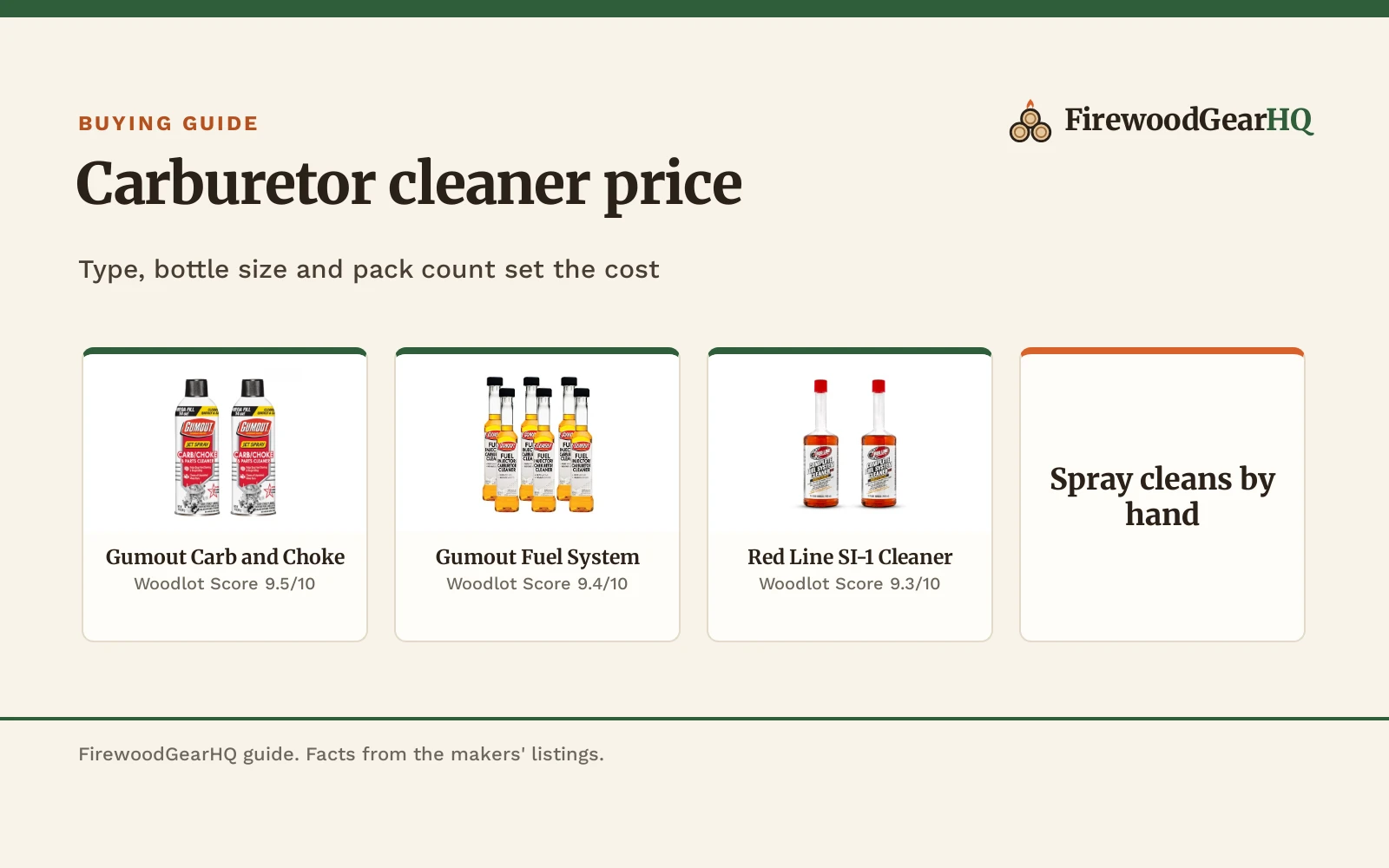
 Gumout 540269 Carb & Choke Jet Spray Carburetor9.5/10View on Amazon
- 2
 Gumout 510021W-6PK Fuel System Cleaner, 6 Pack9.4/10View on Amazon
- 3
 Red Line 60103 SI-1 Complete Fuel System Cleaner9.3/10View on Amazon
Fall prep on a rural property means the saws come out of the shed, the woodpile grows, and the chainsaw has to start cleanly instead of coughing, idling rough, or stalling under load. When a saw that sat all summer struggles, gum and varnish in the carburetor are a common cause. Carburetor cleaner price is the question most owners ask before buying a can, and the answer depends on what kind of cleaner the job needs.
FirewoodGearHQ earns a small commission if you buy through links on this page. The price you pay stays the same. Read our affiliate disclosure.
| # | Product | Woodlot Score | Buy |
|---|---|---|---|
| 1 | Gumout 540269 Carb & Choke Jet Spray Carburetor | 9.5/10 | Buy on Amazon |
| 2 | Gumout 510021W-6PK Fuel System Cleaner, 6 Pack | 9.4/10 | Buy on Amazon |
| 3 | Red Line 60103 SI-1 Complete Fuel System Cleaner | 9.3/10 | Buy on Amazon |
Gumout 540269 Carb & Choke Jet Spray Carburetor
A 14 oz jet spray carburetor cleaner in a pack of 2 that removes gum, varnish, carbon, oil, grease, gunk and dirt from the carburetor, linkages and chokes.
Pros
- Jet spray removes gum, varnish, carbon, oil, grease, gunk and dirt
- Cleans carburetor linkages, chokes, PCV valves and manifold heat controls
- Helps overcome hard starting, rough idling, stalling and high exhaust emissions
- O2 sensor and catalytic converter safe when used as directed
Cons
- Spray only, so it does not treat fuel in the tank
- Made for unpainted metal parts, not painted surfaces
- Leaves no residue, so it leaves no protective film after cleaning
- No warranty term is stated
Gumout 510021W-6PK Fuel System Cleaner, 6 Pack
A 6 oz pour-in fuel system cleaner in a pack of 6 that keeps deposits from forming on indirect fuel injectors, carburetors, intake valves and ports.
Pros
- Keeps deposits from forming to maintain performance and fuel economy
- Prevents carbon build-up on carburetors, intake valves and ports
- Oxygen sensor safe, and safe for turbocharged and supercharged vehicles
- Pack of 6 covers repeat treatments
Cons
- Pour-in only, so it cannot spray a carburetor, linkage or choke clean by hand
- 6 oz bottles are the smallest size in this group
- Prevents deposits rather than stripping heavy existing build-up
- No warranty term is stated
Red Line 60103 SI-1 Complete Fuel System Cleaner
A 15 oz concentrated fuel system cleaner in a pack of 2 that cleans injectors, carburetors, valve and combustion chamber deposits and helps prevent corrosion in fuel systems.
Pros
- Concentrated blend of high-temp and low-temp detergents cleans injectors, carburetors and valves
- One bottle per tank for most effective treatment
- Maker states nearly 100 percent efficiency in one treatment
- Enhances gasoline stability and reduces gum and varnish build-up
Cons
- Pour-in only, so it cannot spray linkages, chokes or metal parts clean by hand
- One bottle per tank, so a pack of 2 covers two tanks
- Made for fuel systems, not as a general-purpose parts cleaner
- The 15 oz bottle is the largest single bottle in this group
The quick answer
Carburetor cleaner price follows the cleaner type, the bottle size and how many bottles come in the pack. A jet spray made for carburetors, linkages and chokes is a different buy from a pour-in treatment that works through the fuel tank, and a pack of 6 small bottles is a different buy from a pack of 2 large ones. Pick the type that matches the job, then compare bottle size and pack count, not the can alone.
What sets carburetor cleaner price
Three things set the cost: the cleaner type, the bottle size and pack count, and the formula with its stated safety claims.
Cleaner type
A spray is applied by hand to the carburetor, linkages, chokes and unpainted metal parts. A pour-in treatment goes in the fuel tank. The Red Line treatment is stated to clean injectors, carburetors, valve and combustion chamber deposits, while the Gumout pour-in is stated to keep deposits from forming on indirect fuel injectors, carburetors, intake valves and ports. The type sets what the cleaner can touch, so it sets the shape of the cost before size does.
Bottle size and pack count
The three picks here show the range: a 14 oz spray in a pack of 2, a 15 oz pour-in in a pack of 2, and a 6 oz pour-in in a pack of 6. A larger bottle holds more per bottle, while a pack of 6 holds more bottles. Compare size and pack count together, since a small bottle in a large pack and a large bottle in a small pack suit different owners.
Formula and stated safety
Concentrated blends and stated safety claims also shape the cost. The Red Line SI-1 (on Amazon) uses a concentrated blend of high-temp and low-temp detergents, and the maker states nearly 100 percent efficiency in one treatment. Both Gumout picks state oxygen sensor safety, and the spray adds 50 state VOC compliance and catalytic converter safety when used as directed.
Carburetor cleaner picks for chainsaw work
The three cleaners below cover the two jobs in this guide: spraying a carburetor clean by hand, and treating the fuel that runs through it.
Spray or pour-in: which type fits the job
Choose by what is dirty and what you can reach. If the carburetor, linkage or choke is gummed up and you can spray it directly, the jet spray fits: it removes gum, varnish, carbon, oil, grease, gunk and dirt, and the maker lists it for chainsaws among trucks, tractors, outboards, ATVs, motorcycles and pressure washers. If the saw runs but the fuel system needs care, a pour-in fits: the Red Line treatment cleans through the tank at one bottle per tank, and the Gumout pour-in keeps deposits from forming on indirect fuel injectors, carburetors, intake valves and ports. A rough idle, hard starting or stalling points toward the spray, since the maker lists those as the symptoms its spray helps overcome, though those symptoms can have other causes.
How to pick one for a chainsaw
Start with the symptom, then match the type, size and pack. The spray is the type made for a carburetor, linkage or choke you can reach by hand, and its maker names chainsaws among its uses and lists hard starting, rough idling and stalling among the symptoms it helps overcome, though those symptoms can have other causes. A pour-in is the type made for the fuel side, and the pour-in makers do not name chainsaws, so follow the bottle directions for your engine before using a pour-in in a saw. Then look at size and pack together: the Red Line maker states one bottle per tank, while the spray amount depends on how dirty the parts are.
FAQ: wood, fire and gear
Can I use carburetor cleaner on a chainsaw?
Yes. The Gumout spray listing names chainsaws among the engines it works on, alongside trucks, tractors, outboards, ATVs, motorcycles and pressure washers. It cleans the carburetor, linkages and chokes, which are the parts that gum up on a saw that sits between seasons.
What is the difference between a spray and a pour-in carburetor cleaner?
A spray is applied by hand to the carburetor and the parts around it, while a pour-in goes in the fuel tank. The spray removes gum, varnish and carbon from the parts you can reach. Of the pour-ins here, the Red Line treatment is stated to clean injectors, carburetors, valve and combustion chamber deposits, while the Gumout pour-in is stated to keep deposits from forming on indirect fuel injectors, carburetors, intake valves and ports.
Does carburetor cleaner help a chainsaw that idles rough?
The Gumout spray maker says its spray helps overcome hard starting, rough idling, stalling and high exhaust emissions. A rough idle can have other causes, so a spray that does not fix it may mean the saw needs a look from someone who works on small engines.
How much carburetor cleaner does one treatment take?
For the Red Line pour-in, one bottle per tank, as the maker states for the most effective treatment. For the spray, the amount depends on how dirty the parts are, since it is applied by hand to the parts that need it.
Is carburetor cleaner safe for oxygen sensors?
Both Gumout picks state oxygen sensor safety. The spray is O2 sensor and catalytic converter safe when used as directed, and the pour-in states oxygen sensor safety and safety for turbocharged and supercharged vehicles. The Red Line listing makes no oxygen sensor claim.
What size carburetor cleaner should I buy?
Match the size and pack to how much cleaning you plan to do. The picks here run from a 6 oz pour-in in a pack of 6 to a 15 oz pour-in in a pack of 2, with a 14 oz spray in a pack of 2 between them. For the Red Line pour-in, the maker states one bottle per tank. The spray and the Gumout pour-in state no per-tank dose, so judge them by bottle size and pack count.
More firewood guides
See the chainsaw gear hub and the best carburetor cleaner for chainsaw picks. Keep the saw cutting with the best chainsaw for firewood and the best chainsaw sharpener, and wear the best chainsaw gloves and the best chainsaw chaps while you work.