Best Chainsaw Chain for Ripping Logs: 5 Milling Chains Compared
Five chainsaw chains for ripping logs compared by pitch, gauge, drive link count, cutter grind, steel and warranty, from 20-inch to 36-inch guide bars.
 By FirewoodGearHQ Editorial
Updated October 9, 2026
By FirewoodGearHQ Editorial
Updated October 9, 2026
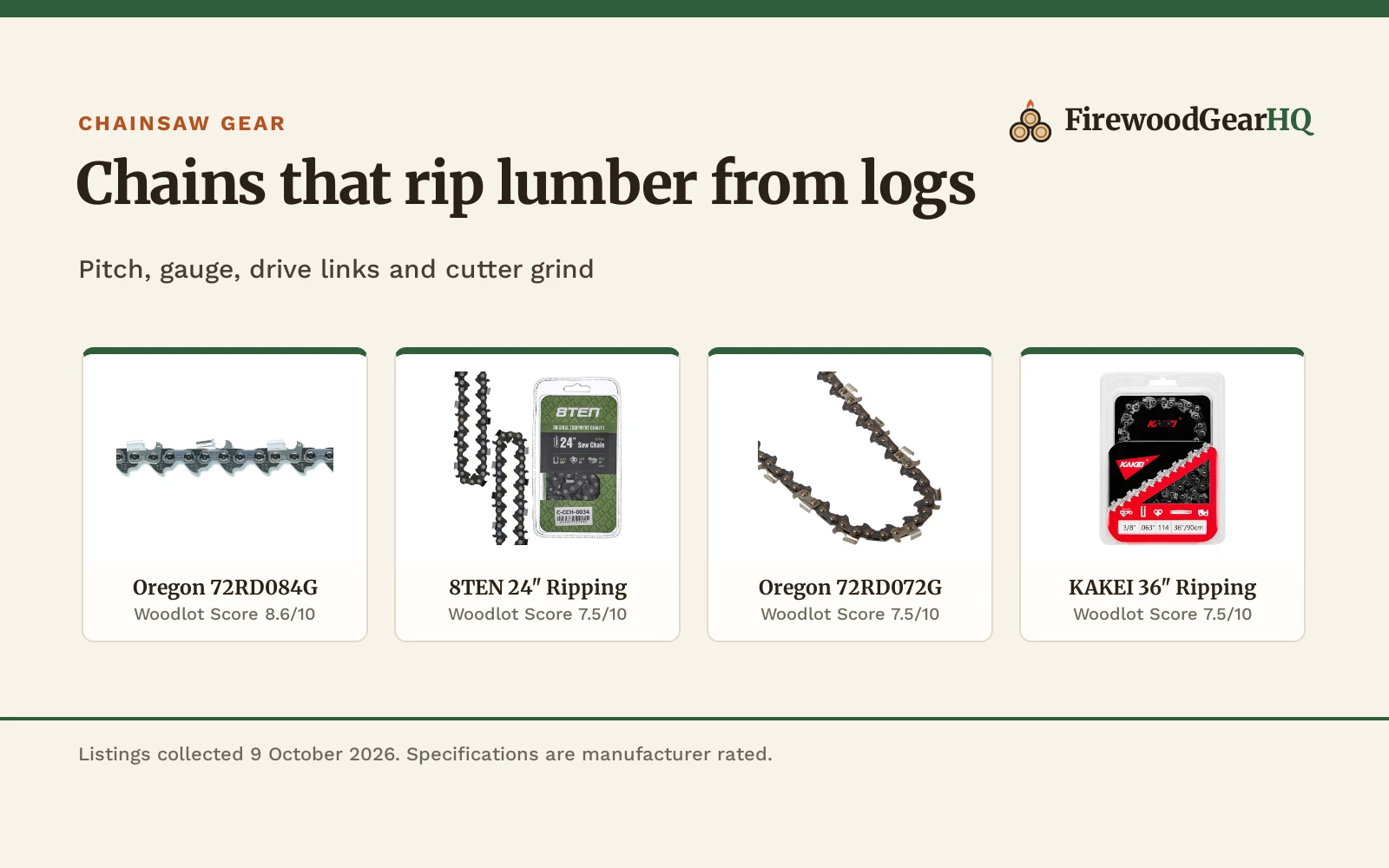
Finding the best chainsaw chain for ripping logs comes down to matching your guide bar length, drive link count, pitch and gauge to a dedicated ripping cutter profile. Unlike standard cross-cut chains that sever wood fibers across the grain for firewood, a ripping chain uses specialized cutter geometry to slice along the grain for milling smooth slabs and boards. This guide compares five chainsaw chains for ripping logs across 20-inch, 24-inch and 36-inch setups, evaluating drive link counts, steel specifications, stated vibration reduction and manufacturer warranty coverage.
FirewoodGearHQ earns a commission when you buy through links on this page, at no extra cost to you. Affiliate disclosure.
Quick picks
- Best Overall Oregon 72RD084G: Dedicated factory ripping grind on an 84-link chain for 24 in bars, with LubriLink oiling and Vibe-ban vibration reduction. Check price
- Best Stated Warranty 8TEN 24″ Ripping: 24 in ripping chain with 84 drive links, extensive saw fitment and a stated 810-day limited warranty. Check price
- Best for 20 in Bars Oregon 72RD072G: 72 drive link ripping chain for 20 in bars, featuring factory ripping cutters, LubriLink tie straps and Vibe-ban chassis design. Check price
- Best for 36 in Milling KAKEI 36″ Ripping: 114 drive link semi-chisel ripping chain made from German steel with Japanese chrome-plated cutters for 36 in guide bars. Check price
Compare the picks
| Model | Woodlot Score | Bar / length | Drive links | Pitch and gauge | Cutter type | Warranty (stated) |
|---|---|---|---|---|---|---|
| Oregon 72RD084G | 8.6/10 | 27.2 in (listed) | 84 | 3/8 in, .050 in | Ripping chain | Not stated |
| 8TEN 24″ Ripping | 7.5/10 | 24 in | 84 | 3/8 in, .050 in | Ripping (full chisel in table) | 810 days |
| Oregon 72RD072G | 7.5/10 | 20 in (1 in in table) | 72 | 3/8 in, .050 in | Ripping chain | Not stated |
| KAKEI 36″ Ripping | 7.5/10 | 36 in | 114 | 3/8 in, .063 in | Semi-chisel ripping | Not stated |
| Archer 24″ Ripping | 7.0/10 | 24 in | 84 | 3/8 in, .050 in | Semi-chisel | Not stated |
Specifications are manufacturer rated, collected 9 October 2026. Weights and dimensions are as listed in product specifications. Only one of these listings states a concrete warranty term.
The picks
| Award | Product | Woodlot Score About the HQ ScoreThe Woodlot Score runs from 0 to 10 and weighs performance (35%), build (25%), value (25%), safety (10%, where it applies) and warranty (5%), using only what the manufacturer and the listing publish. How we pick › | |
|---|---|---|---|
 OREGON 72RD084G 84 Drive Link 3/8-Inch Ripping Saw
|
8.6/10 | Buy | |
 8TEN Ripping Chainsaw Chain 24" Bar .050 Gauge 3/8
|
7.5/10 | Buy | |
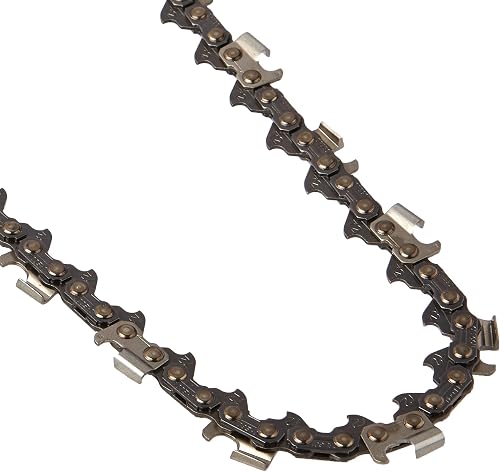 OREGON 72RD072G 72 Drive Link 3/8-Inch Ripping Saw
|
7.5/10 | Buy | |
 KAKEI 36 Inch Chainsaw Ripping Chain 3/8" Pitch
|
7.5/10 | Buy | |
 Archer 24" 3/8-050-84DL Ripping Chainsaw Chain
|
7.0/10 | Buy |
OREGON 72RD084G 84 Drive Link 3/8-Inch Ripping Saw
An 84 drive link, 3/8 in pitch, .050 in gauge ripping saw chain built with standard chassis parts, a dedicated ripping grind, LubriLink tie straps and Vibe-ban vibration reduction.
Pros
- Factory ripping cutter grind designed for chain-type sawmills
- Vibe-ban chassis design stated to reduce vibration 25% or more at the handles
- LubriLink tie straps help keep oil on the chain during cuts
- Standard sequence 84 drive link count with 3/8 in pitch and .050 in gauge
Cons
- Listing explicitly notes it is not recommended for hand-held use
- Spec table lists item length as 27.2 in rather than naming a bar length
- No warranty term is stated on this listing
- Ripping cutter grind cuts slowly when cross-cutting logs
8TEN Ripping Chainsaw Chain 24" Bar .050 Gauge 3/8
A 24 in, 84 drive link ripping chain in 3/8 in pitch and .050 in gauge, compatible with Husqvarna, Stihl and Echo saws, backed by an 810-day limited warranty.
Pros
- Stated 810-day limited warranty in the listing table
- 24 in bar fitment with 84 drive links, 3/8 in pitch and .050 in gauge
- Extensive compatibility list covering Husqvarna, Stihl, Echo and Dolmar saws
- Cross-references multiple OEM part numbers from Husqvarna, Stihl and Echo
Cons
- Spec table contradicts bullets on steel type: 51CrV4 German steel vs 68CrNiMo33 steel
- Spec table lists chain type as full chisel despite title stating ripping chain
- Pin material contradicts rivet material: GRST65D steel vs GCr15 steel
- Listed weight is 14.4 oz, slightly heavier than comparable chains
OREGON 72RD072G 72 Drive Link 3/8-Inch Ripping Saw
A 20 in, 72 drive link ripping saw chain in 3/8 in pitch and .050 in gauge with factory ripping cutters, LubriLink tie straps and Vibe-ban vibration reduction.
Pros
- Factory ripping cutter grind tailored for 20 in guide bars
- Vibe-ban chassis design stated to reduce vibration 25% or more at the handles
- LubriLink tie straps help keep bar oil distributed along the chain
- Standard sequence 72 drive links with 3/8 in pitch and .050 in gauge
Cons
- Listing explicitly notes it is not recommended for hand-held cutting
- Spec table contains a clerical error listing item length as 1 in
- No warranty term is stated on this listing
- Included components is listed as No in the spec table
KAKEI 36 Inch Chainsaw Ripping Chain 3/8" Pitch
A 36 in, 114 drive link semi-chisel ripping chain in 3/8 in pitch and .063 in gauge, constructed from German steel with hardened rivets and Japanese chrome-plated cutters.
Pros
- Long 36 in length with 114 drive links for large log slabbing
- German steel construction with temperature control and punching system
- Hardened and quenched rivets stated to reduce chain tension stretch
- Japanese chrome-plated cutters cold-headed with rotary grinding
Cons
- Listing explicitly states chain does not comply with low kickback requirements
- Spec table rounds gauge to 0.06 vs .063 in title and bullets
- Not for cross cutting firewood; slabbing and board making only
- No warranty term is stated on this listing
Archer 24" 3/8-050-84DL Ripping Chainsaw Chain
A 24 in, 84 drive link semi-chisel ripping chain in 3/8 in pitch and .050 in gauge made from Japanese steel, replacing Oregon 72RD084G.
Pros
- Direct replacement for Oregon 72RD084G and A1EP-RP-84E ripping chains
- 24 in length with 84 drive links, 3/8 in pitch and .050 in gauge
- Listing states chain is made from Japanese steel
- Semi-chisel cutter profile for milling lumber from logs
Cons
- Extremely thin listing with only a single bullet point
- Spec table repeats replacement part numbers as the model number
- No warranty term is stated on this listing
- No lubrication or vibration dampening features described
How we scored them
Each chain is scored out of 100 on performance, build, value, safety and warranty, using only what the listing publishes. The weights are on our How We Pick page.
| Product | Woodlot Score | Perf. /35 | Build /25 | Value /25 | Safety /10 | Warranty /5 |
|---|---|---|---|---|---|---|
| Oregon 72RD084G | 8.6 | 33 | 22 | 22 | n/a | 0 |
| 8TEN 24″ Ripping | 7.5 | 28 | 16 | 20 | n/a | 3 |
| Oregon 72RD072G | 7.5 | 30 | 19 | 21 | n/a | 0 |
| KAKEI 36″ Ripping | 7.5 | 29 | 20 | 20 | n/a | 0 |
| Archer 24″ Ripping | 7.0 | 27 | 18 | 19 | n/a | 0 |
Scores run from 0 to 10. Safety counts only for powered gear or where the listing states safety features; where it does not apply, the score is taken over the remaining 90 points.
Buying guide: choosing the best chainsaw chain for ripping logs
Ripping chain vs cross-cut chain
A standard chainsaw chain is designed for cross-cutting, where cutter teeth sever wood fibers across the grain to buck firewood logs. Ripping cuts run parallel to the wood grain, slicing long ribbons of wood rather than small chips. Running a standard cross-cut chain in a chainsaw mill produces rough surfaces, bogs the powerhead and creates excessive heat. A dedicated ripping chain features modified cutter geometry designed specifically for chain-type sawmills, creating smoother boards with less strain on the saw.
Understanding pitch, gauge and drive links
Before ordering any replacement chain, you must verify three critical specifications stamped on your guide bar: pitch, gauge and drive link count. Pitch represents the spacing between drive links, with 3/8 in being the size shared across all five picks. Gauge measures the thickness of the drive link that rides inside the guide bar groove, listed as .050 in or .063 in on these models. The drive link count is the exact number of drive links that fit your bar length and drive sprocket, covering 72, 84 and 114 links among these models. A chain with an incorrect drive link count will not fit your guide bar safely.
Cutter profiles: standard sequence and semi-chisel
Ripping chains in this comparison feature either standard sequence chassis with factory ripping grinds or semi-chisel cutter profiles. Standard sequence ripping chains, like Oregon 72RD, use standard chassis components with cutters ground specifically for slabbing along the grain. Semi-chisel cutters feature rounded working corners that hold their edge longer when milling dirty or gritty bark. The choice depends on whether you value smooth planed surfaces or edge retention in tough logs.
Sawmill setup, bar length and power requirements
Ripping along the log grain requires substantially more sustained power than bucking firewood. Chainsaw milling puts continuous load on the engine, guide bar and chain. For 20 in and 24 in guide bars, mid-size to large powerheads are typically used, while massive 36 in setups require heavy-duty powerheads capable of pulling 114 drive links through wide logs. Auxiliary bar oilers or pressurized oil delivery are frequently added to chain sawmills to keep the chain cool during extended slabbing passes.
Milling safety and kickback awareness
Ripping chains do not comply with low kickback performance standards. Because cutter teeth are ground to slice wood parallel to the grain, the kickback zone at the bar nose presents significant risk. Manufacturers explicitly state that ripping chains are designed for chain-type sawmills and are not recommended for hand-held cutting. Always operate within an approved chainsaw mill frame. Essential protective equipment includes chainsaw chaps, a safety helmet with face screen and hearing protection, heavy-duty gloves and steel-toe boots. Never operate a chainsaw mill alone, and consult the OSHA logging safety guidelines for best practices.
Wear eye protection and gloves for cutting, splitting and handling, follow every tool's manual, install stoves to code, and have the chimney inspected and cleaned every year. See EPA Burn Wise and NFPA heating safety. Read our Safety Disclaimer.
Frequently Asked Questions
What is chainsaw chain pitch and gauge?
Pitch is the distance between the drive links of the chain, commonly 3/8 in for heavy-duty and milling chains. Gauge is the measured thickness of the drive link tang that rides inside the guide bar slot, such as .050 in or .063 in. Both numbers must match your chainsaw guide bar and drive sprocket precisely.
How to choose the correct chainsaw chain for ripping logs?
First, check the side stamp on your guide bar or consult your saw manual for the exact pitch, gauge and drive link count. Next, select a chain specifically labeled as a ripping chain or designed for chain-type sawmills. Standard cross-cut chains should not be used for slabbing lumber, as they produce rough finishes and excessive motor strain.
Why does my chainsaw chain keep loosening when milling?
Ripping logs generates continuous friction and heat along the entire guide bar, causing the metal chassis and drive links to expand. In addition, new chains experience rivet bedding during initial use. Always verify that your bar oiler is functioning properly, keep chain tension snug before starting a pass, and allow the chain to cool before readjusting tension.
How to replace a chainsaw chain on a milling bar?
Loosen the bar nuts and release the chain tensioner on your chainsaw powerhead. Remove the clutch cover, lift the old chain off the drive sprocket and guide bar, and clean sawdust from the bar groove. Loop the new ripping chain over the sprocket and around the bar nose, ensuring the cutter edges face forward along the top of the bar. Reinstall the clutch cover, adjust the tension screw until the tie straps touch the bottom of the bar rail, and torque the bar nuts securely.
Can you use a ripping chain for cross cutting firewood?
No. Ripping chains are specifically engineered for cutting parallel to the wood grain on sawmills. Using a ripping chain to cross-cut firewood results in very slow cutting speeds, rough cuts and increased kickback hazard. Keep dedicated cross-cut chains for bucking firewood rounds.
Related guides
Explore our complete coverage of cutting equipment on the chainsaw gear hub and the main chainsaws section, or browse high-powered gas chainsaws and the best heavy duty gas chainsaws for milling setups. To mount your ripping chain, read our guide to the best portable chainsaw lumber mills. Keep your cutters sharp between slabbing passes with the best chainsaw sharpener. If you need standard cross-cut chains for cutting firewood rounds rather than slabbing, see our roundups of the best chainsaw chains, the best chainsaw chain for hardwood, and the best chainsaw chain for professional use, as well as bar-specific picks including the best 18 inch chainsaw chain and the best 16 inch chainsaw chain.
About the author
The FirewoodGearHQ editorial team researches firewood and wood heating equipment from published specifications, ratings and warranty terms, and scores every pick the same way. We do not run our own product trials.