Best Stove Cement (2026): 5 Picks Compared
Five stove cements compared: gasket vs furnace formulas, temperature ratings, tube vs cartridge vs pail, and setting times, ranked.

On this page
Top picks at a glance
As an Amazon Associate we earn from qualifying purchases.
- 1
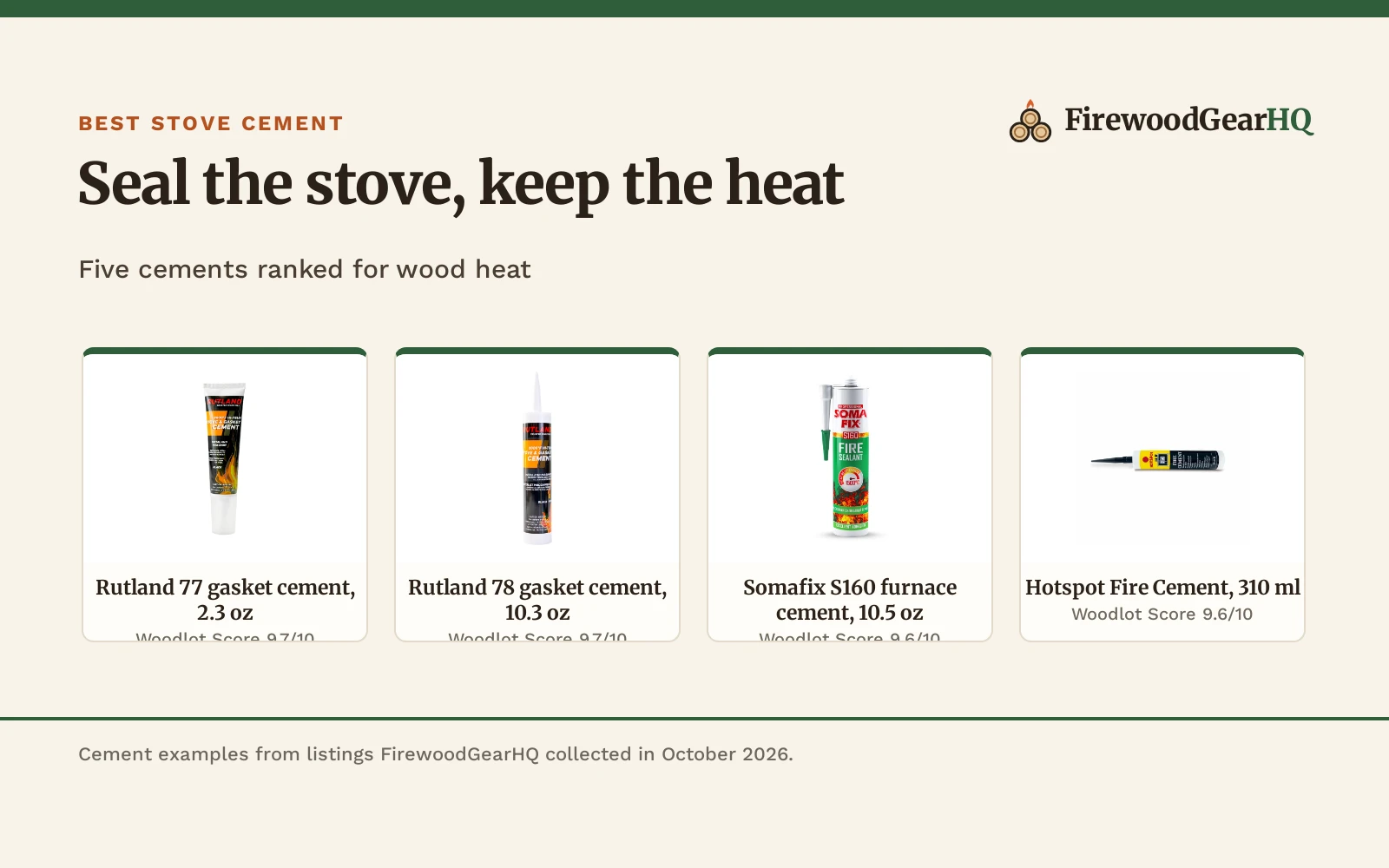
 Best OverallRutland 77 gasket cement, 2.3 oz9.7/10View on Amazon
- 2
 Best Large CartridgeRutland 78 gasket cement, 10.3 oz9.7/10View on Amazon
- 3
 Highest HeatSomafix S160 furnace cement, 10.5 oz9.6/10View on Amazon
- 4
 Best Color ChoiceHotspot Fire Cement, 310 ml9.6/10View on Amazon
A wood stove door that leaks smoke, a gasket rope that has come loose, a hairline crack in the firebox: these are small jobs that a tube of stove cement fixes in an afternoon. Stove cement is a heat-resistant paste or putty that seals joints, bonds gasket rope and patches cracks in stoves, furnaces and chimneys, hardening into a seal that stands up to firebox temperatures. This guide names the best stove cement from five current listings, ranked on temperature rating, size, features and stated warranty, with a buying guide that explains which formula fits which job.
FirewoodGearHQ may earn a small commission if you buy through links on this page. The price you pay stays the same. Read our affiliate disclosure.
Quick picks
- Best Overall Rutland 77 gasket cement, 2.3 oz: 2000F gasket cement with the only stated warranty here, 18 months, in a precise 2.3 oz tube. Check price on Amazon
- Best Large Cartridge Rutland 78 gasket cement, 10.3 oz: 10.3 oz cartridge of the same 2000F formula with 1000 psi tensile strength. Check price on Amazon
- Highest Heat Somafix S160 furnace cement, 10.5 oz: 2732F rating, sets within minutes, for furnaces, boilers and fireboxes. Check price on Amazon
- Best Color Choice Hotspot Fire Cement, 310 ml: Black or buff, non-toxic and water resistant, for visible repairs. Check price on Amazon
The picks

Rutland Original Wood Stove Gasket Cement
A 2.3 oz tube of 2000F gasket cement for sealing door gasket rope and furnace joints, with the only stated warranty here at 18 months.
Pros
- Rated to 2000F for firebox and furnace joints
- 18-month warranty, the only stated warranty here
- Paintable once fully hardened; adheres fiberglass gasket to metal
- USA brand founded in 1883
Cons
- Only 2.3 oz, for small repairs
- States not water resistant
- Must be heated to fully harden
- Tube format, not a caulking cartridge

Rutland Original Wood Stove Gasket Cement
A 10.3 oz cartridge of the same 2000F gasket cement formula with 1000 psi tensile strength, for larger gasket and joint jobs.
Pros
- Rated to 2000F for firebox and furnace joints
- 10.3 oz cartridge covers larger jobs
- 1000 psi tensile strength stated
- USA brand founded in 1883
Cons
- No warranty stated in the listing
- Cartridge needs a caulking gun
- Black only
- Putty form, less precise than a tube for dabs
Furnace Cement (2732°F) Heat Resistant Refractory
A 10.5 oz cartridge of furnace cement rated to 2732F, the highest here, that sets within minutes for fireboxes, flues and boilers.
Pros
- Rated to 2732F, the highest here
- Sets within minutes, per the listing
- Fits any standard caulking gun
- Bonds brick, ceramic, concrete and metal
Cons
- No warranty stated in the listing
- Black only
- Water resistance stated as a feature but not detailed
- 0.45 kg, heavier to handle than tubes
Hotspot Fire Cement 310ml
A 310 ml cartridge of fire cement in black or buff, non-toxic and water resistant, for sealing stoves, fireplaces and chimneys.
Pros
- Choice of black or buff color
- Non-toxic formulation stated
- Water resistant
- Thermo-setting resins and inorganic fillers
Cons
- No temperature number stated
- No warranty stated in the listing
- 310 ml, smaller than the 10.3 and 10.5 oz cartridges
- High viscosity needs a firm hand

United States HDW MFG/U S HA KK0068-A 8OZ Hi-Temp
An 8 oz pail of gray silicate furnace cement, water resistant and high viscosity, for general stove and masonry repairs.
Pros
- 8 oz pail suits trowel and scoop application
- Water resistant
- High viscosity stays where put
- Gray color for masonry matching
Cons
- No temperature number stated
- No warranty stated in the listing
- Thinnest listing of the five
- Compatible materials list includes wood, oddly
Compare the picks
| Rutland 77 | Rutland 78 | Hotspot | Somafix S160 | Imperial KK0068-A | |
|---|---|---|---|---|---|
| Best for | Gasket rope, small repairs | Gasket rope, larger jobs | Stove and chimney sealing | High-heat furnace joints | General masonry repairs |
| Temp rating | 2000F | 2000F | Not stated | 2732F | Not stated |
| Size | 2.3 oz tube | 10.3 oz cartridge | 310 ml cartridge | 10.5 fl oz cartridge | 8 oz pail |
| Color | Black | Black | Black or buff | Black | Gray |
| Warranty | 18 months | Not stated | Not stated | Not stated | Not stated |
Specifications are manufacturer stated, as published on each listing and collected 22 October 2026.
How we scored them
Each cement is scored on price value, build, stated features, safety listing and warranty, with the weights published on our How We Pick page. Stove cements carry no electrical safety listing, so every pick scores zero there; heat ratings count under stated features instead. Only one listing here states a warranty, the Rutland 77’s 18 months, so warranty separates the field and lifts the 77 to the top of the ranking.
| Product | Woodlot Score | Perf. /35 | Build /25 | Value /25 | Safety /10 | Warranty /5 |
|---|---|---|---|---|---|---|
| Rutland 77 gasket cement, 2.3 oz | 9.7 | 30 | 21 | 21 | n/a | 2 |
| Rutland 78 gasket cement, 10.3 oz | 9.7 | 30 | 22 | 21 | n/a | 0 |
| Somafix S160 furnace cement, 10.5 oz | 9.6 | 30 | 22 | 20 | n/a | 0 |
| Hotspot Fire Cement, 310 ml | 9.6 | 29 | 21 | 20 | n/a | 0 |
| Imperial KK0068-A furnace cement, 8 oz | 9.5 | 28 | 20 | 19 | n/a | 0 |
Scores run from 9.2 to 9.8: each product’s point total is placed on that range, so more points always means a higher score. Safety counts only for powered gear or where the listing states safety features; where it does not apply, the score is taken over the remaining 90 points.
Buying guide: choosing the best stove cement
Temperature rating
The rating tells you where the cement can live. Both Rutland listings are rated to 2000F for firebox and furnace joints, which covers stove doors, gasket channels and the joints around a firebox. The Somafix S160 is rated to 2732F, the highest here, and suits furnaces, boilers and fireboxes at extreme heat where the extra headroom matters. The Hotspot and Imperial listings claim high-temperature resistance without stating a number, which leaves the rating unclear rather than settling it. Match the rating to the hottest spot you will seal: a stove door gasket is well served by 2000F, while a furnace firebox rewards the higher number. When in doubt, buy the higher rating; the cost difference is small and the margin is real.
Gasket cement vs furnace cement
Gasket cement is made for one job: bonding fiberglass gasket rope to stove doors and sealing the small joints around it. Both Rutland listings are gasket cements, paste and putty that spread like silicone gasket glue, and the Rutland 77 listing specifically says it adheres any fiberglass gasket to most any metal. Furnace or refractory cement is the broader repair material: the Somafix, Hotspot and Imperial listings cover fireboxes, flues, chimneys, boilers and masonry joints, with the Somafix listing naming stoves, ovens, fire bricks, boilers, chimneys, garage firewalls, grills and flues. Buy gasket cement for rope and door seals; buy furnace cement for cracks, joints and masonry. Using gasket cement on a big masonry crack wastes a precise product on a rough job, and using furnace cement for a delicate gasket reset makes a fiddly job harder.
Tube, cartridge or pail
Packaging decides how the cement goes on. The Rutland 77 comes in a 2.3 oz tube for precise small repairs, dabs and touch-ups where a fingertip of cement is enough. The Rutland 78, Hotspot and Somafix come in cartridges, with the Somafix stated to fit any standard caulking gun for clean, controlled application along long seams; the Rutland 78’s 10.3 oz cartridge is the format for full door-gasket replacements and multi-stove jobs. The Imperial comes in an 8 oz pail you scoop or trowel from, which suits masonry joints and firebox patching better than bead work. Cartridges suit long seams and joints; tubes suit dabs and touch-ups; pails suit trowel work on masonry. If you own one caulking gun already, the cartridge picks slot straight into your kit.
Setting time and heat hardening
Read the setting instructions before you light the stove. The Rutland 77 states heat hardening is required and that it hardens from the air; the Somafix states it sets within minutes and hardens to a rock-solid finish. The Hotspot uses thermo-setting resins and inorganic fillers, which implies it also hardens with heat. Plan the job so the cement fully hardens before the stove runs hard, and follow the listing’s hardening instructions exactly: lighting a full fire over unset cement is how seals fail early. A gentle first fire after the stated setting time is the usual way to finish the job.
Color: black, buff or gray
Most stove cements are black, which disappears against a black stove and black stovepipe. The Hotspot is the only listing here offering a choice, black or buff, which matters for visible repairs on lighter fireplaces where a black smear would show. The Imperial is gray, which blends with masonry and mortar joints. For a door gasket on a black stove, black is the invisible choice; for a light masonry fireplace, buff blends better; for mortar-colored joints, gray. The Rutland 77 adds that it is paintable once fully hardened, so a small visible repair can be touched up afterward.
Water resistance
Stove cement lives indoors, but chimneys and outdoor repairs see weather. The Hotspot and Imperial listings state water resistant, and the Somafix listing states water resistance as a feature. The Rutland 77 states not water resistant, which is fine for its intended job inside the firebox and on the door. For chimney caps, flashing and flue work exposed to rain, favor a water resistant pick; for interior gasket work, it does not matter.
How much cement do you need
Buy for the job, not the shelf. A 2.3 oz tube covers a gasket reset on one stove door with room to spare; a 10.3 or 10.5 oz cartridge covers a full door gasket plus seams, or several small stoves; an 8 oz pail covers trowel-applied masonry patching. Cement does not keep forever once opened, so the giant size is only a bargain if you will use it. For a single stove, the small tube or one cartridge is the right call; for a shop that maintains several stoves, the 10.3 and 10.5 oz cartridges earn their keep.
Storage and shelf life
Unopened, stove cement keeps well in a cool, dry shop; opened, it starts to skin over and harden, especially the air-hardening formulas. Cap tubes tightly, seal cartridges with the nozzle plug, and keep pails lidded. The Rutland 77’s 18-month warranty covers defects in material and manufacture, which is a useful backstop if a tube arrives dried out. If the cement is crumbly or separated in the container, do not try to revive it; a failed seal costs more than a fresh tube.
Working safely
Stove cement is a chemical product going into a hot appliance, so treat it with respect. Work in ventilation, wear gloves, and keep the cement off skin and out of eyes; the Hotspot listing states a non-toxic formulation, which is a plus for indoor fireplace work. Let the stove cool fully before you start, and keep the work area clear of ash and dust so the cement bonds to clean metal or masonry. Once hardened, the seal is inert, but the wet product deserves the same care as any shop chemical.
Install stoves and inserts to the manufacturer's instructions and your local code, usually by a certified installer with a permit and inspection. Keep the listed clearances to combustibles, run working smoke and carbon monoxide detectors, have the chimney inspected and cleaned every year to prevent creosote fires, burn only seasoned wood, and check local burn rules. See EPA Burn Wise, NFPA heating safety, CPSC carbon monoxide guidance and the Chimney Safety Institute of America (CSIA). Read our Safety Disclaimer.
Frequently Asked Questions
What is stove cement?
A heat-resistant paste or putty for sealing joints, bonding stove door gasket rope and patching cracks in wood stoves, furnaces, fireplaces and chimneys. It hardens into a seal that stands up to firebox temperatures. Gasket cement targets rope and door seals; furnace cement covers the broader repair jobs.
How long does stove cement take to dry?
It varies by product. The Somafix listing states it sets within minutes; the Rutland 77 hardens from the air and requires heat to finish hardening. Always follow the listing’s hardening instructions and let the cement fully harden before running the stove hard; a gentle first fire after the stated setting time is the usual finish.
Can you use cement board behind a wood stove?
Cement board is a different product from stove cement: a rigid heat-shield panel, not a paste. This guide covers stove cement pastes and putties for sealing and patching. For heat shields behind a stove, look at stove board and clearance guidance, not this page.
Gasket cement or furnace cement: which do I need?
Gasket cement if you are resetting door gasket rope or sealing small seams; furnace cement if you are patching firebox cracks, flue joints or masonry. The Rutland 77 and 78 are gasket cements; the Somafix, Hotspot and Imperial are furnace cements. Match the formula to the job and the temperature rating to the hottest spot.
How do I clean fire cement off a stove?
Wipe cement that has not set with a damp cloth before it hardens; hardened cement usually needs careful scraping with a plastic or wood tool to avoid scratching the finish. The Rutland 77 states it is paintable once fully hardened, so a small visible repair can be touched up with stove paint like the paint in our stove pipe paint guide.
Related: stove accessories, best stove pipe elbow, chimney flashing vs step flashing, best stove pipe fan and the wood stoves section.