Hand Crank vs Electric Chainsaw Sharpener: Which One Should You Buy?
Hand crank and electric chainsaw sharpeners compared on how they sharpen, power, angle control and where you use them, with two examples from each side.

On this page
Top picks at a glance
As an Amazon Associate we earn from qualifying purchases.
- 1
 Chainsaw Sharpener Jig Kit with Carry Bag9.5/10View on Amazon
- 2
 Sharp Pebble Electric Cordless Chainsaw Sharpener Kit9.5/10View on Amazon
- 3
 QTG Manual Chainsaw Sharpener9.4/10View on Amazon
Verdict: Choose a hand crank sharpener if you sharpen at the woodlot or on the tailgate with no outlet: it clamps to the bar and works anywhere. Choose an electric sharpener if you sharpen at the bench and want speed: a motor-driven wheel or rotary bit does the job faster than turning a crank by hand.
A dull chain makes dust instead of chips, and the woodpile does not wait for a shop visit. The hand crank vs electric chainsaw sharpener question comes down to where you sharpen and how fast you want it done. This comparison lays out how each side sharpens, what power and speed each offers, how each controls the angle, and where each belongs, with two examples from each side.
FirewoodGearHQ may earn a small commission if you buy through links on this page. The price you pay stays the same. Affiliate disclosure.
| # | Product | Woodlot Score | Buy |
|---|---|---|---|
| 1 |  Electric Chainsaw Sharpener Kit | 9.5/10 | Buy on Amazon |
| 2 | 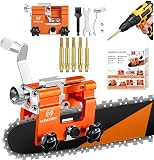 Chainsaw Sharpener Jig Kit with 5 Diamond | 9.4/10 | Buy on Amazon |
| 3 |  Chainsaw Sharpener Jig Tool for 4-22" Saw Chains | 9.4/10 | Buy on Amazon |
| 4 |  Electric Chain Saw Sharpener Wall | 9.3/10 | Buy on Amazon |
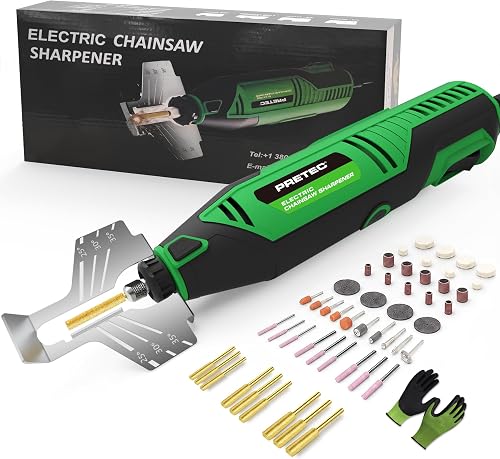
Electric Chainsaw Sharpener Kit
A 120V electric rotary sharpener kit with 54 accessories, 6 speeds from 1000 to 35,000 RPM and a 35°/30°/25° angle attachment.
Pros
- 6 speeds from 1000 to 35,000 RPM
- 54-piece kit with 9 diamond bits in 3 sizes
- Preset 35°/30°/25° angle attachment
- Pure copper motor stated for continuous use
Cons
- No warranty term stated
- No safety certification stated
- 54 pieces to keep track of and store
- 120 volt outlet required, not a field tool
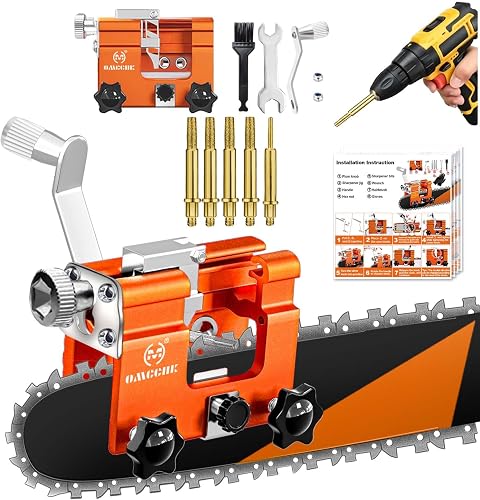
Chainsaw Sharpener Jig Kit with 5 Diamond
A hand crank chainsaw sharpener jig for 4 to 22 in chains with a fixed 30° angle, gloves and a cleaning brush included.
Pros
- Fits 4 to 22 in chains, gas and electric saws
- Fixed 30° angle with pawl-guided teeth
- Protective gloves and cleaning brush included
- Manuals in 6 languages
Cons
- Title says 5 diamond bits while bullets say 10 tungsten bits
- No warranty term stated
- No safety certification stated
- Free replacement is support, not a warranty term

Chainsaw Sharpener Jig Tool for 4-22" Saw Chains
A manual hand crank chainsaw sharpener for 4 to 22 in chains with a 30° guide angle, 3 burr stones, a wrench and a cleaning brush.
Pros
- Fits 4 to 22 in chains
- Fixed 30° sharpening angle
- Kit with 3 burr stones, wrench and brush
- Rust-resistant alloy construction stated
Cons
- Spec table claims 1000 watts on a manual tool
- No warranty term stated; the lifetime line is after-sales fluff
- No safety certification stated
- 3 bits is the smallest kit here
Electric Chain Saw Sharpener Wall
A 120V bench-style electric chain sharpener at 5000 rpm and 90 watts with a 35° wheel, wall/bench/vise mount and 6.6 lb weight.
Pros
- 5000 rpm grinding at 90 watts
- Wall, bench or vise mount with table vise included
- 35° cutting angle stated
- Chain clamp handle included
Cons
- Title brand Chicago Faucets vs manufacturer Chicago Electric
- Bullets say only 'Sold on Amazon'
- Warranty type limited with no term stated
- 6.6 lb plus mount, not portable
Side by side
| Sharpener | Side | Power | Angle | Chain fit | Weight |
|---|---|---|---|---|---|
| PRETEC 54pc Rotary Kit | Electric | 120V, 1000-35,000 RPM | 35°/30°/25° | Not stated | Not stated |
| OMCCHK 5-Bit Crank | Hand crank | Manual | Fixed 30° | 4 to 22 in | 9.9 oz |
| OMCCHK 3-Bit Crank | Hand crank | Manual | Fixed 30° | 4 to 22 in | Not stated |
| Chicago Electric 90W | Electric | 120V, 90 W, 5000 rpm | 35° | Not stated | 6.6 lb |
Example figures are manufacturer rated, collected 20 October 2026. Where a spec table disagrees with the title and bullets, the notes are in each review.
Hand crank vs electric chainsaw sharpener: how each sharpens
A hand crank sharpener is a jig that clamps to the bar. You position the pawl on the tooth, drop the burr into the guide sleeve and turn the handle; the OMCCHK listings describe two fixed sharpening holes and a 30° angle, with the pawl keeping each tooth in the same position. Nothing plugs in, so it works at the stump, on the tailgate or in the truck bed.
An electric sharpener spins the abrasive for you. The Chicago Electric example is a bench-style unit: the chain clamps in and a motor-driven wheel grinds each tooth at 5000 rpm. The PRETEC is a rotary tool kit: a handpiece with angle attachment and diamond bits, running 6 speeds from 1000 to 35,000 RPM. Both need a 120 volt outlet, so they live at the bench, not in the woods.
Power and speed
The hand crank side states no power at all, because there is none: your arm is the motor. (One OMCCHK spec table lists Horsepower: 1000 watts on a manual tool, which is plainly an error; trust the title and bullets.) The OMCCHK 3-bit listing claims a dull chain is restored in 3 to 5 seconds of cranking, which is the maker’s claim, not a measured figure.
The electric side states its power plainly: the Chicago Electric lists 90 watts at 5000 rpm on 120 volts, and the PRETEC lists a copper motor with 6 speeds from 1000 to 35,000 RPM. A motor does not get tired, so the electric side wins on sustained speed at the bench; it loses the moment there is no outlet.
Angle control and chain sizes
Both OMCCHK hand crank jigs fix the angle at 30° through their guide holes, which keeps every tooth consistent without measuring. The Chicago Electric wheel is set at a 35° cutting angle, and the PRETEC angle attachment offers preset 35°, 30° and 25° positions. Match the angle to what your chain calls for; the listings do not state chain pitch compatibility beyond size.
On chain size, the hand crank side is explicit: both OMCCHK listings state fit for 4 to 22 inch chains, covering most gas and electric saws. Neither electric listing states a chain size range, so check your chain against the wheel or bit before buying.
Where you sharpen
The hand crank jigs are made for the field: the OMCCHK 5-bit listing weighs 9.9 ounces, both fold into a kit with a brush (and gloves on the 5-bit), and neither needs power. The electric side is made for the shop: the Chicago Electric mounts to a wall, bench or vise and weighs 6.6 pounds, while the PRETEC is a handheld rotary kit that still needs its 120 volt supply. Many woodcutters end up with both: the crank in the saw box, the electric on the bench.
Four examples
How we scored them
Each example is scored on performance, build, value, safety and warranty, using only what the listing publishes. The weights are published on our How We Pick page.
| Product | Woodlot Score | Perf. /35 | Build /25 | Value /25 | Safety /10 | Warranty /5 |
|---|---|---|---|---|---|---|
| PRETEC 54pc Rotary Kit | 9.5 | 30 | 20 | 21 | 0 | 0 |
| OMCCHK 5-Bit Crank | 9.4 | 28 | 19 | 20 | 0 | 0 |
| OMCCHK 3-Bit Crank | 9.4 | 27 | 19 | 19 | 0 | 0 |
| Chicago Electric 90W | 9.3 | 27 | 19 | 18 | 0 | 0 |
Scores run from 9.2 to 9.8: each product’s point total is placed on that range, so more points always means a higher score.
Wear eye protection and gloves for cutting, splitting and handling, follow every tool's manual, install stoves to code, and have the chimney inspected and cleaned every year. See EPA Burn Wise and NFPA heating safety. Read our Safety Disclaimer.
Frequently Asked Questions
Can I sharpen a chainsaw chain by hand?
Yes. A hand crank jig clamps to the bar and files each tooth at a fixed angle with no power needed. A round file and guide also works; see electric chainsaw sharpener vs file for the trade-offs.
What angle should I sharpen my chain at?
It depends on the chain. Both OMCCHK jigs fix 30°, the Chicago Electric wheel is set at 35°, and the PRETEC attachment offers 35°, 30° and 25°. Match the angle to your chain’s specification.
How do I know the chain needs sharpening?
When it starts making dust instead of chips, pulls to one side, or needs pressure to cut, it is dull. Sharpen before it gets fully blunt; a sharp chain is safer and faster than a dull one.
Will an electric sharpener overheat the teeth?
Any grinder can overheat a tooth with heavy pressure. Take light passes and let each tooth cool; the listings here state no thermal guidance, so go easy and check your work.
Which sharpener is better for field use?
The hand crank side. It needs no outlet, the OMCCHK 5-bit listing weighs 9.9 ounces, and both come as portable kits. The electric examples need 120 volts, so they stay at the bench.
Related guides
See the chainsaw gear hub, electric chainsaw sharpener vs file, the best chainsaw sharpener for square ground chain, how to use a stump vise and the best portable chainsaw sharpener.